How to read cat body language, ears to tail

Cat body language is read best as a whole: flattened ears with wide pupils point to fear or aggression, and a change in a cat’s usual signals needs a vet.
Table of Contents
The tail is the one part you can read across a room
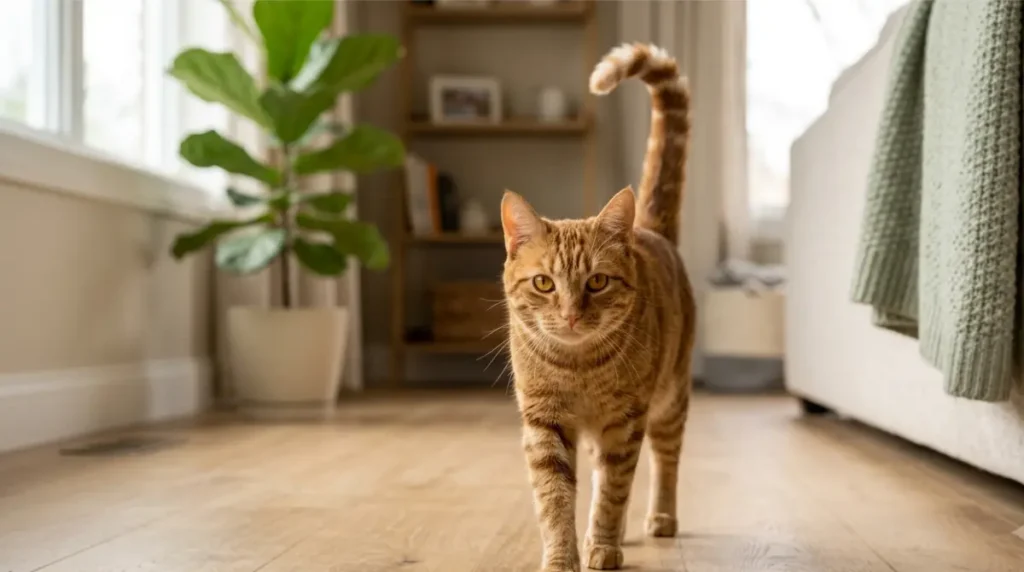
From the doorway, before your cat has turned her head, the tail already shows her intent. Held vertically, often with the tip curved over, it is the friendly approach cats use with people and other animals, usually with pricked ears and relaxed whiskers (iCatCare).
| Tail | What it usually signals | Your move |
|---|---|---|
| Upright, tip curved over | Friendly approach | Let her come to you |
| Held out, sweeping slowly side to side | Frustration | Look for what she wants and can’t reach |
| Tucked under or wrapped tight to the body | Anxiety or fear | Give her space and a way out |
| Puffed up, back arched, standing sideways | Stay-away warning | Back off without reaching for her |
| Thumping the floor while she crouches | Defensive | Stop and step back |
Sources: iCatCare, RSPCA Australia, Cornell.
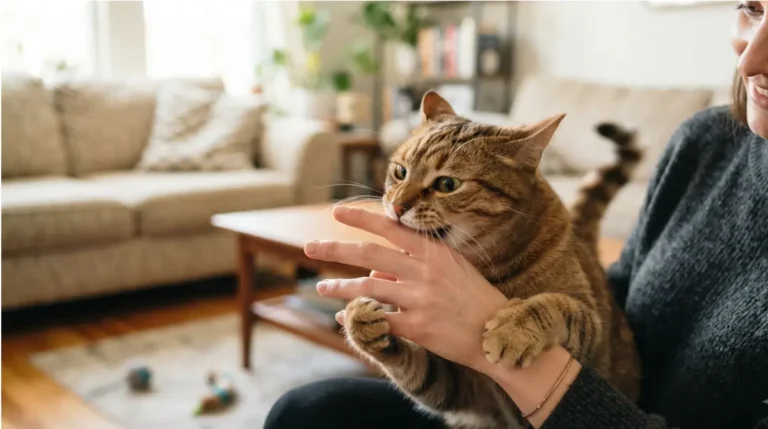
Movement changes the reading. Tail lashing often comes before a petting bite, along with dilated pupils and ears moving back (Cornell). The earlier, quieter warnings are covered in why cats bite during petting.
In a multi-cat home: a puffed tail with a sideways, arched stance is also how one cat tells another to keep its distance (iCatCare). If you see it between cats who used to get along, start with how to reintroduce cats who suddenly start fighting.
Ear angles and whisker set, from relaxed to defensive
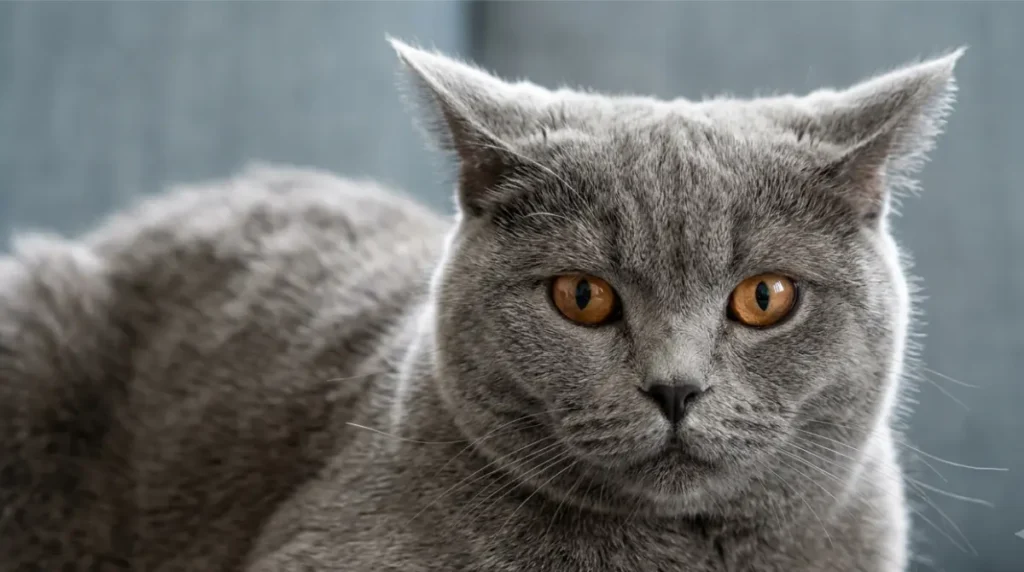
Cornell’s feline guidance separates a frightened face from an aggressive one mainly by the ears. Fear flattens the ears outward and presses the whiskers down against the face. Aggression flattens the ears backward and holds the whiskers out to the sides (Cornell).
Other welfare groups draw the line differently. iCatCare reads upright ears rotated outward, with small pupils, as frustration (iCatCare). An angry cat standing with an arched back holds its ears lowered and out to the side (RSPCA Australia). Sideways “airplane” ears tell you the cat is uncomfortable. Her eyes and posture tell you which kind.
Relaxed whiskers point straight out and sit fairly close together. A tense or highly alert cat fans them forward, and a frightened one flattens them against her cheeks in a tight bunch (iCatCare). Straight, forward-pushed whiskers are also one of the five signs on the Feline Grimace Scale, covered in the facial signs of pain in cats.
What do the eyes and pupils add?
The slow blink, and how to return it
Cats half-blinked and narrowed their eyes more often when their owners slow-blinked at them, in a 2020 study of 21 cats from 14 homes (Scientific Reports). In a second experiment, cats were more likely to approach a stranger’s outstretched hand after she slow-blinked than after she kept a neutral face.
To return a slow blink, copy the owners in that study. Sit about 3 feet (1 m) in front of your cat, wait until she looks at you, then close your eyes for longer than half a second. The researchers describe the slow blink as a likely sign of positive emotion and say more work is needed before firm conclusions.
Hard stares and wide pupils mean different things
A wide-eyed stare with little blinking turns up when cats face off, or when a cat is fixed on a threat (iCatCare). Pilot trials for the slow-blink study suggested cats may read a person’s direct eye contact as threatening too.
Wide pupils go with fear and with aggression, and also show up before a play attack or a petting bite (Cornell). They tell you a cat is worked up; her ears and the situation tell you why.
A cat showing its belly isn’t asking for a rub
A hand on an offered belly can be met with a bite or a scratch, and the cat isn’t misbehaving (Cats Protection). Rolling over is a social roll, usually a friendly greeting or a sign she feels at ease or wants to play (iCatCare). Unspayed females also roll during courtship.
Most cats would rather be greeted with a stroke on the head or cheeks (Cats Protection).
A relaxed belly-up cat lies stretched out with her eyes often half-closed and her mouth shut. A cat lying flattened and partly rolled onto one side, ears pinned back and teeth showing, wants you to stay away (RSPCA Australia).
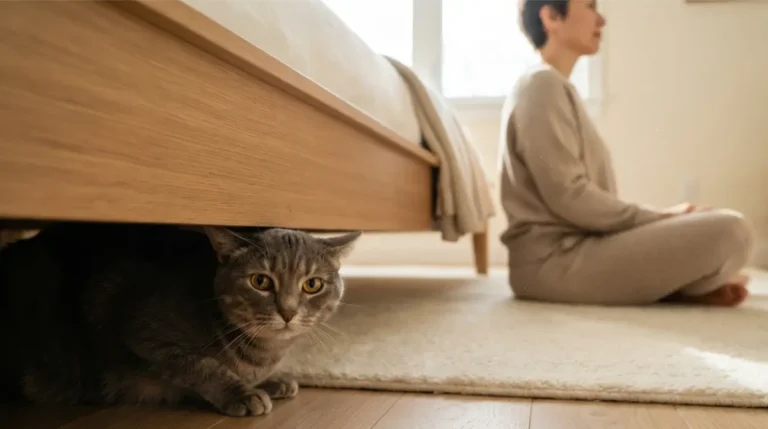
Fear looks different again. A frightened cat pulls her head in and keeps her body low, all four paws on the floor in case she needs to run (iCatCare).
One signal, two meanings
Wide pupils are only the clearest example. Several other signals change meaning with the rest of the body, and on some of them the welfare groups disagree.
| Signal | One reading | Another reading | What separates them |
|---|---|---|---|
| Dilated pupils | Fear, with ears flat (iCatCare, Cornell) | Aggression, a play attack or a bite during petting (Cornell) | The ears and what’s going on around her |
| Ears turned out to the side | Fear (Cornell) or worry (RSPCA) | Frustration with upright ears and small pupils (iCatCare); anger in a standing, arched cat (RSPCA) | Pupil size and posture |
| Arched back, raised fur | Aggression (Cornell) | A defensive stay-away signal (iCatCare) | Nothing that changes your response |
| Whiskers pushed forward | Tense or highly alert (iCatCare) | One of the facial signs vets score for pain | Squinting eyes and a lowered head |
| Belly up | Friendly greeting or play (iCatCare) | Defensive, with a flattened body and teeth showing (RSPCA) | A loose body or a tense one |
Sources: iCatCare, Cornell Feline Health Center, RSPCA Australia.
Purring also shows up in more than one emotional state, which why cats purr when they’re not happy covers. Whichever reading is right, your response is the same: stop touching her, leave her a way out and look for what set her off.
Watch your cat when nothing is happening
Spend a few minutes this week watching your cat while she rests, before anything has upset her.
- Note how she carries her tail lying down and walking toward you.
- Look at her ear and whisker position when she is awake but idle.
- Take a short phone video of her face to compare against later.
A change in her usual signals calls for a vet visit before any behavior fix, especially new
when she’s touched in one spot. Hyperthyroidism, osteoarthritis, dental disease and nervous system problems can all make a cat aggressive (Cornell). The wider list of which cat behaviors are normal and which need a vet helps you judge what else has shifted. If something already has, book the appointment and bring the video.