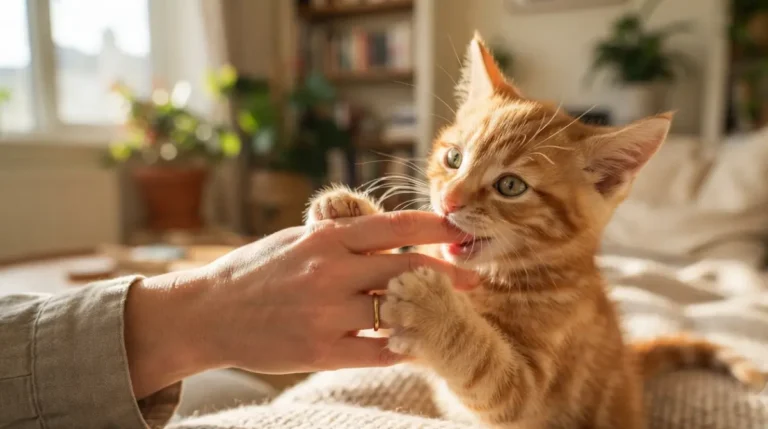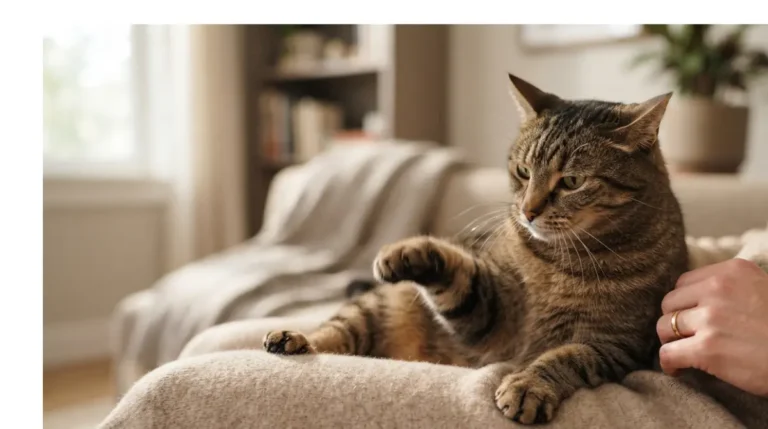
Why does my cat bite me — the common signals owners overlook

Why your cat bites during petting is rarely sudden — researchers found cats prefer the cheeks and head, and dislike the tail base most of all.
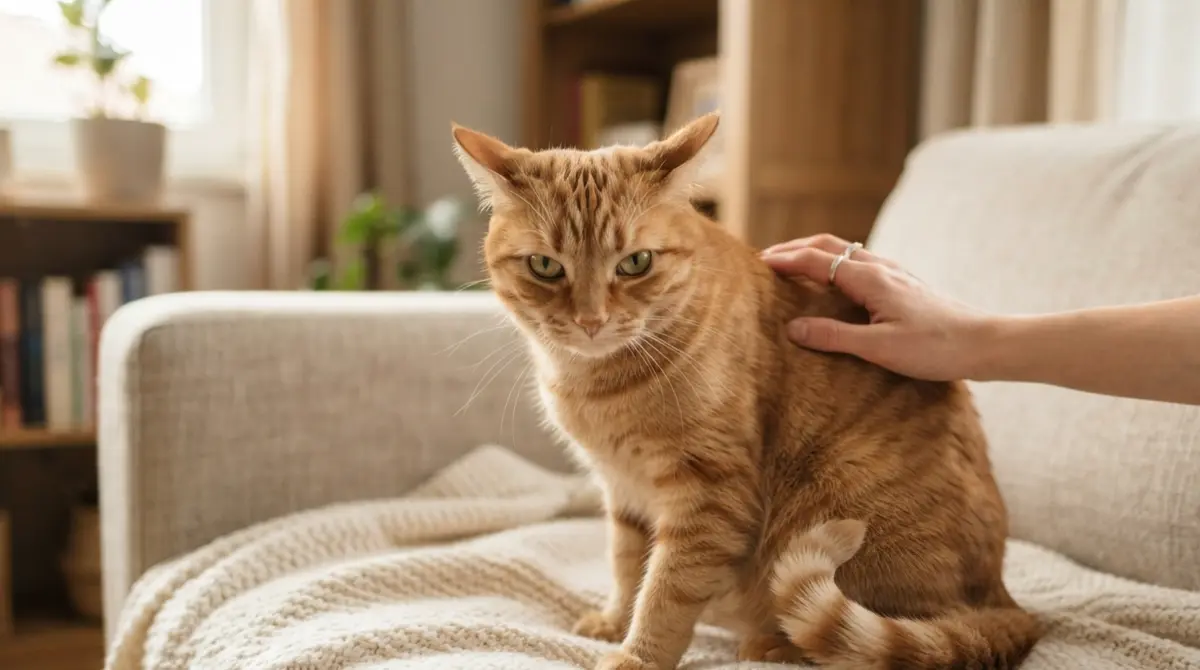
Table of Contents
Your cat wasn’t being mean — here’s what actually happened
You were stroking a purring cat, and then there were teeth. The behaviour has a name: petting-induced aggression, also called overstimulation biting, and it is communication rather than an attack.
🚨 Get Medical Help Today If: the bite broke your skin — especially on a hand, finger, wrist, face, or over a joint. Cat teeth make narrow punctures that look minor and seal over fast. Call a doctor or urgent care the same day rather than waiting to see how it looks tomorrow. Full detail is in the next section.
Was that a love bite or a real bite?
A gentle mouthing that doesn’t break skin, alongside a loose body and slow blinking, is different from a grab-and-run with a tense body. Both are messages. Only one needs a doctor.
Where to go from here
If your cat has only recently started biting, or bites when you touch one particular spot, skip ahead to the section on pain. Everyone else: the signals came first, and they are learnable.
Purring is not permission. A cat can purr through the entire build-up and still be asking you to stop. Biting during petting is one of several cat behaviours that look alarming and usually aren’t, and which cat behaviours are normal and which need a vet maps the rest.
ℹ️ Vet Note: This article explains a common feline behaviour. It is not a diagnosis and not medical advice. Biting that is new, getting worse, or triggered by touching one specific part of your cat’s body should be assessed by a veterinarian, because pain is a frequent and treatable cause.
When a cat bite needs a doctor, not a bandage
Any cat bite that punctures the skin is worth a same-day call to a doctor or urgent care, and hand, finger, wrist, face and over-joint bites are the highest priority.
The reason is mechanical. Cat teeth are narrow and sharp, so they drive bacteria deep into tissue while the surface wound closes over quickly, leaving very little to see.
🚨 Get Medical Help Now If: redness spreads outward from the wound, red streaks track up the limb, the area is swollen, hot or leaking fluid, you cannot bend the finger or joint, or you develop fever or chills. Go to urgent care or an emergency department rather than a phone consultation. Bites from a stray cat, or one whose vaccination status you don’t know, also raise a rabies question for the clinician.
Wash the wound with soap and water while you arrange care. Zoonoses are part of the picture too: the CDC’s guidance on cat scratch disease notes that bites, and licks on broken skin, can transmit it — not scratches alone.
Anyone immunocompromised, diabetic, pregnant or elderly, and any bitten child, should be seen even when the wound looks trivial.
Why petting goes from good to too much
Repeated stroking that feels pleasant at first can start to feel like too much, and the bite is how a cat ends the conversation.
🔍 Why Cats Do This: Cornell’s overview of feline aggression is direct that the reasons are not fully established. The two leading explanations are overstimulation and the cat controlling when the petting ends. Long full-body strokes are also not a natural feline interaction — cats groom and rub each other in short bouts around the face and cheeks, not in sweeping passes down the back.
Why he bites the moment you stop
Some cats bite at the pause rather than mid-stroke. That fits the second explanation: the cat is managing the interaction, not reacting to the sensation.
Why he purrs right up until the bite
Purring happens in more than one emotional state, so it is a poor consent signal on its own. Read the body, not the sound.
This isn’t kitten play biting
A kitten ambushing your hands is practising predatory behaviour, which is a separate problem with a separate fix — as is the gentle nibbling that comes with kneading. This article is about a cat that accepted the contact first, then ended it.
The warning signs most owners miss

The bite is rarely the first message. These are the signals cats give during petting, from subtle to unmistakable:
- The tail tip starts twitching or the tail swishes against the floor
- Ears rotate sideways or flatten backwards
- The skin along the back ripples or twitches
- Your cat licks their nose, shakes their head, or suddenly grooms for a few seconds
- Purring stops, rubbing stops, and the body goes still
- The head turns sharply toward your hand
- Pupils widen
The first four are easy to miss and easy to learn. The last three mean stop now, not in a moment. The Merck Veterinary Manual’s guide to feline behaviour problems notes that much feline aggression is subtle and passive, which is exactly why these get overlooked.
🐾 Life-Stage Note: A senior cat may skip the early signals and go straight to a late one. So may a cat who has learned that quiet signals get ignored. In both cases, the shortened warning is itself worth mentioning to your vet.
Why children miss these
A tail-tip twitch is beyond most young children to read in real time. In a household where a cat has bitten during petting, an adult supervises and children are taught to stroke briefly, then stop.
Where you’re petting matters more than how long
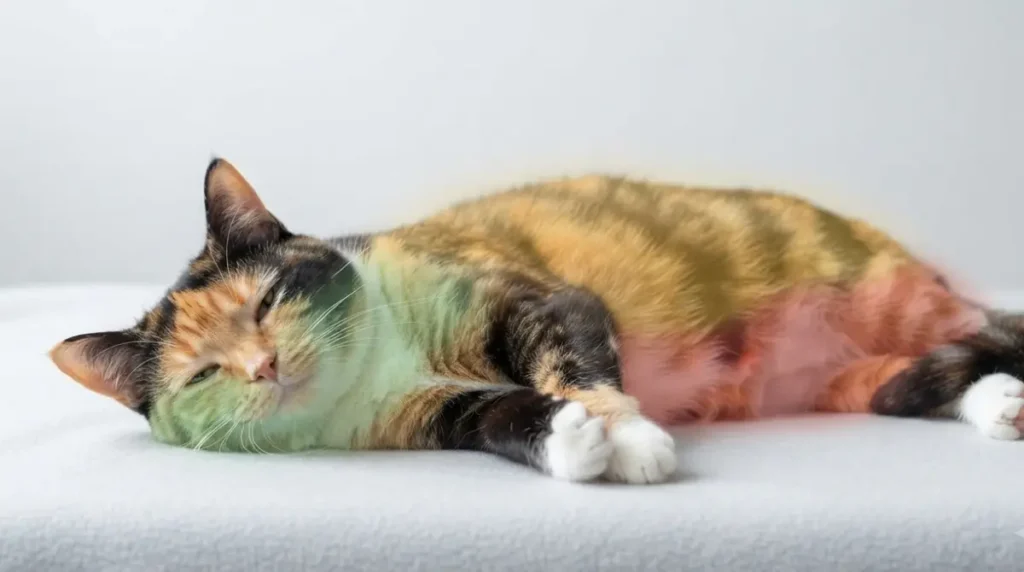
Where your hand goes changes how quickly a cat reaches its limit. Researchers at Nottingham Trent University, led by Dr Lauren Finka, set out the pattern in the C.A.T. guidelines for cat-friendly interaction:
| Zone | Most cats | Key detail |
|---|---|---|
| Cheeks, head, chin | Usually welcome | Scent-gland areas cats use in friendly contact |
| Upper body, chest, tail | Varies by individual | Watch for signals; treat as unproven ground |
| Stomach, base of tail | Usually not | Most sensitive; a common trigger for a sudden bite |
📊 Sourced: Two published studies point the same way. Soennichsen and Chamove (Anthrozoös, 2002) found cats responded most positively to stroking between the eyes and ears, and worst around the tail. Ellis and colleagues (Applied Animal Behaviour Science, 2015) re-ran it with stronger methods and found the tail-base region scored most negatively regardless of whether the handler was familiar. Honest caveat: the 2002 study used only nine cats, and later authors flagged real methodological problems with it. Two studies agreeing is a good signal, not settled science.
International Cat Care’s guidance on cat-friendly interaction adds a practical rule: let the cat initiate, and stroke in the direction of the coat.
🐾 Life-Stage Note: Mats pull the skin, so long-haired cats often have sore patches along the back. Stiff, thin-skinned older cats may resent firm pressure on the spine and hips that they tolerated at five.
When the biting is pain, not personality
No amount of retraining helps a cat with a painful tooth. Two patterns move this out of behaviour and into medicine: biting that is new in a cat who never did it, and biting tied to one specific body area.
Pain lowers tolerance for touch sharply. Veterinary guidance on recognising pain in cats treats behavioural change as a primary indicator, and stresses that pain assessment in cats differs from dogs.
What your vet will check
Expect an oral exam, an ear exam, and careful palpation along the spine, limbs and abdomen, with imaging or bloodwork depending on what they find.
✅ Do This: Before the appointment, note when the change started, which spot triggers it, and whether your cat has also changed how they jump, groom, eat or use the litter box. A short phone video of the reaction is worth more than a description.
How to pet your cat without getting bitten
Let your cat start it. Offer a loose hand, and take a cheek rub against it as the invitation.
Then use the three-second check from the C.A.T. guidelines: stroke for roughly three seconds, pause, and see whether your cat re-initiates contact. If they don’t, they’re done for now. Stopping while your cat still wants more is what raises the threshold over time.
What not to do
⚠️ Watch Out: Cornell is explicit that physical punishment and restraint make this worse. No nose flicks, no scruffing, no holding a cat in place to finish the stroke. Let a cat who has had enough walk away, and reward brief, light stroking with a treat before the limit rather than after the bite.
Common questions about cats biting during petting
1. Why does my cat bite me then lick me?
Licking and gentle mouthing both occur in friendly contact. The bite ends the interaction; the lick is social behaviour, not an apology.
2. Why does my cat bite me then lick me?
Licking and gentle mouthing both occur in friendly contact. The bite ends the interaction; the lick is social behaviour, not an apology.
3. Why does my cat bite me when I stop petting him?
One leading explanation is that the cat controls when contact ends. Biting at the pause fits that pattern rather than a reaction to the stroking itself.
4. What’s the difference between a love bite and a real bite?
A love bite doesn’t break skin and comes with a loose body. A real bite comes with tension, a sharp head turn, and usually a fast exit.
5. Why does my cat purr and then bite me?
Purring occurs in several emotional states, so it isn’t a reliable consent signal. Read the tail, ears and body instead.
6. Should I punish my cat for biting?
No. Cornell advises against physical punishment and restraint, which make petting-induced biting worse. Let your cat leave and reward brief stroking instead.
7. Do I need to see a doctor for a cat bite?
If it punctured the skin, yes — call the same day, especially for hand, face or joint bites. Spreading redness, red streaking or fever means go to urgent care now.
8. Why is my cat suddenly biting when he never used to?
Sudden onset, or biting tied to one body area, points toward pain rather than temperament. Book a veterinary exam before trying any behavioural fix.
9. How long should I pet my cat for?
It depends on the individual cat and the zone: cheeks and chin buy far longer than the tail base. Use the three-second pause to let your cat set the length.
What to do the next time you sit down together
Watch the tail tip, and stop at the first twitch. Stroke for three seconds, pause, and let your cat ask for more.
A cat who wants shorter sessions isn’t a less affectionate cat — just one telling you plainly where their limit sits. That’s worth knowing.