The Overlooked Reasons Why Cats Purr When They Are Upset

Why cats purr has less to do with happiness than owners assume. Kittens purr from a few days old; adults purr at the clinic. Context tells you more.
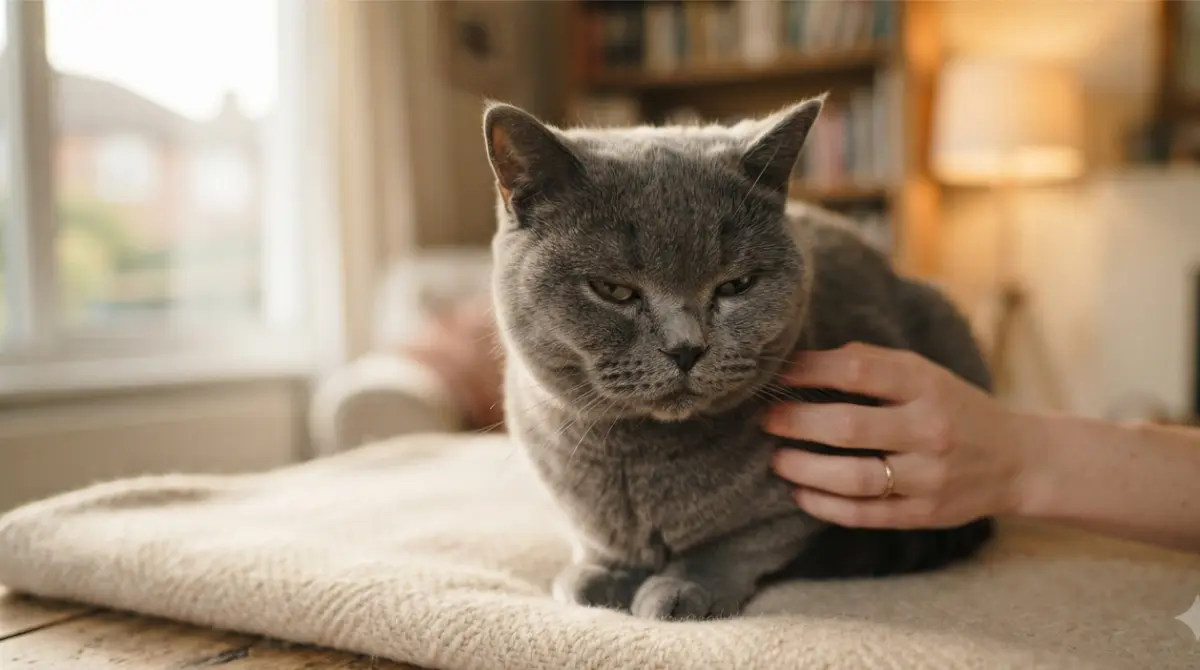
Table of Contents
Your cat is purring and something still feels wrong. Trust that. Purring is not a happiness meter, and owners who sense a mismatch are usually reading their cat correctly.
🚨 Go to a Vet Now If: your cat is purring alongside open-mouth or laboured breathing, straining or crying in the litter box, collapse, hiding somewhere it never hides, refusing food for more than 24 hours, a known injury, or suspected poisoning. Call your veterinarian or nearest emergency clinic straight away.
If none of those apply, you have time. Worried owners should read the next section first. Curious owners can skip to what purring actually is. For the wider picture of which cat behaviors are normal and which need a vet, start with our pillar guide.
ℹ️ Vet Note: This article explains why cats purr in situations that are not happy ones. It is not a diagnosis, and purring neither confirms nor rules out illness or pain. Never give your cat medication intended for people or dogs. If purring comes with breathing changes, litter box changes, or not eating, contact your veterinarian.
When a purring cat needs a vet right now
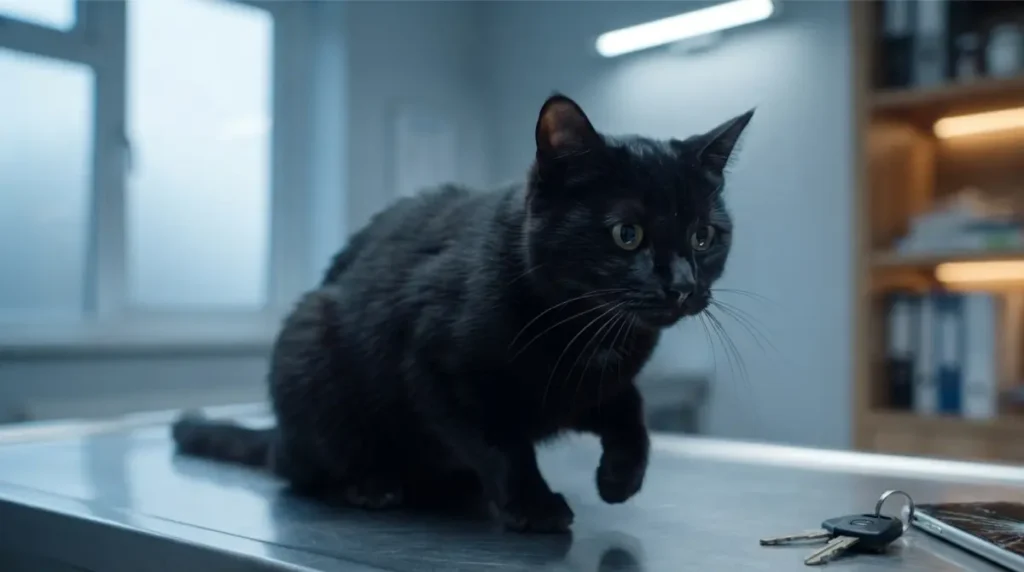
Purring never earns a cat a delay. If any sign below is present, the purr is irrelevant to the decision.
Signs that mean go tonight
- Open-mouth breathing, fast breathing, or visible effort to breathe
- Straining in the litter box, crying in the box, or producing nothing — urinary obstruction is life-threatening and hours matter, and it is far more common in male cats, as Cornell’s guidance on feline urinary tract disease explains
- Collapse, unsteadiness, seizures, or sudden repeated vomiting
- Known trauma, a fall, or suspected contact with a toxin
Signs that mean call in the morning
- Not eating for a day, or eating noticeably less for two
- New hiding, new reluctance to jump, or a change in litter box habits
- Any change that has lasted more than 48 hours
When a sign could sit in either list, treat it as the first list.
What purring actually is (and what it is not)
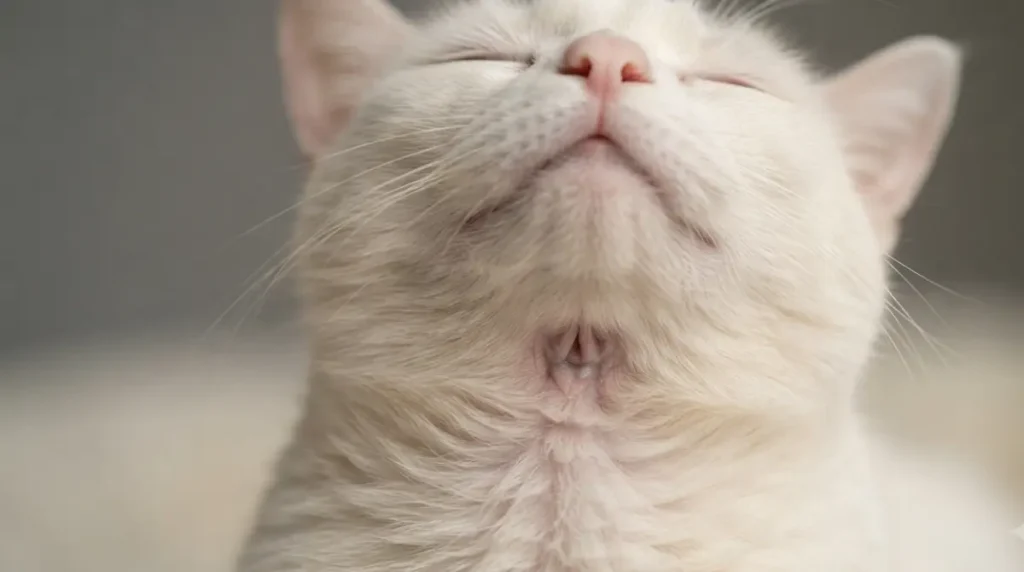
Cats purr because purring is a largely reflexive vocalisation used across many situations — greeting, nursing, self-soothing, asking for something, and enduring stress or pain. It is a behavior, not an emotional readout. What tells you how your cat feels is the context around the sound, not the sound itself.
How a cat makes the sound
🔍 Why Cats Do This: The purr is produced at the larynx, where the vocal folds separate rapidly as the cat breathes. A 2023 study found isolated cat larynges could make purr-like sound without ongoing nerve input, though that work was done outside the body and the question stays open.
Why purring is not a mood reading
Purring sits among the closed-mouth “murmur” sounds in International Cat Care’s guide to how cats communicate, alongside the chirrup — sounds cats use for greeting and contact across a wide variety of contexts. The popular idea that purring heals bones remains an untested hypothesis, not an established fact.
Six reasons a cat purrs when it is not happy
Six situations produce a purr that has nothing to do with contentment: self-soothing under stress, pain, illness, asking for food or attention, recovery after injury or surgery, and the end of life.
Self-soothing under stress
Cats purr under duress — in carriers, at the clinic, in a new home. The purr appears to regulate the cat, not to report that the cat is fine.
Pain and illness
Cats instinctively hide weakness, which is why behavioural change is the principal indicator of pain rather than obvious distress. A purr sits comfortably on top of real pain. Senior cats matter most here: undiagnosed arthritis and dental disease are common, and owners read the slowing down as age.
Asking for something
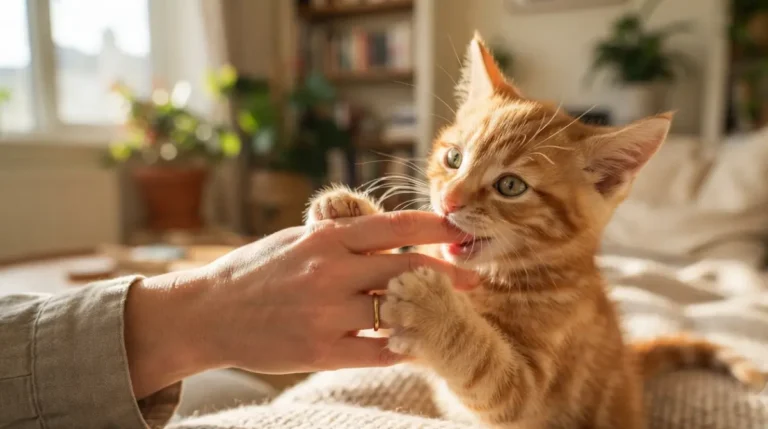
Research published in Current Biology in 2009 identified a solicitation purr — food-seeking purrs carry an embedded cry-like component that listeners rated as more urgent and less pleasant. Cats that knead or nip while purring are often mid-request too, which our guide to kneading and biting behaviour covers.
At the end of life
Purring is reported in cats who are dying and is consistent with self-soothing. It is not evidence your cat is comfortable, and it is not a message meant for you — however much we would like it to be.
How to read the purr in front of you
The purr alone will not tell you which of those six you are looking at. The rest of the cat will. Run this check now.
| What else is true right now | What it suggests | What to do |
|---|---|---|
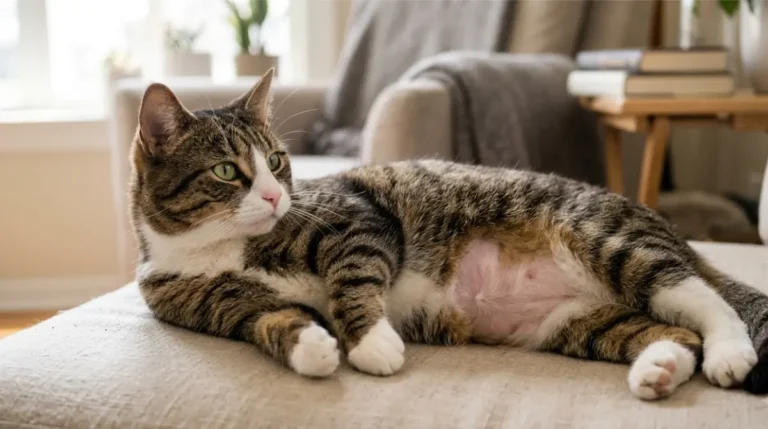
| Loose posture, soft eyes, tail up, purr softens when you move away | Ordinary contact purring | Nothing |
| Crouched, ears turned out, eyes squeezed, whiskers pulled forward | Possible pain or fear | Call your vet today |
| Purr continues unchanged whatever you do | Unreadable — sound is not tracking context | Call your vet today |
| Any red-flag sign from Section 2 | Emergency | Go now |
Facial signs adapted from the five action units in a validated scale that reads pain from a cat’s facial expression — ear position, eye tightening, muzzle tension, whiskers and head position.
What this check cannot tell you
It cannot diagnose, and it cannot clear your cat. It needs a baseline you only have if you know this cat well — new adopters should lower their threshold for calling. Cats that bite during affection, covered in our guide to biting while being petted, show how quickly a contented signal flips.
Why age, situation and breed change the answer
The same purr carries different weight depending on the cat making it.
🐾 Life-Stage Note: Kittens purr from a few days old, while nursing and greeting, so purring tells you almost nothing about a kitten’s health. In senior cats the opposite holds — a higher background rate of hidden pain makes a purr weaker evidence of comfort.
Cats purr routinely at the clinic, after surgery, and in the first days in a new home. That purr is duress, not enjoyment, and it is the single most misread purr owners encounter.
⚠️ Watch Out: In flat-faced breeds such as Persians and Exotics, purring and laboured breathing are genuinely easy to confuse. If you cannot tell which you are hearing, treat it as laboured breathing and call.
What your vet will check — and what to bring
Because pain assessment in cats rests largely on behaviour, the AAFP and AAHA pain management guidelines treat owner observation as central — especially for pain that has built slowly.
✅ Do This: Before the appointment, note when the behaviour started, what changed around it, the last meal, the last confirmed urination, and film 20 seconds of the behaviour on your phone. If the exam finds nothing, ask whether a pain trial or a recheck is appropriate.
Common questions about cat purring
1. Do cats purr when they are in pain?
Yes. Cats purr when stressed, injured or ill, so purring never rules pain out. If you suspect pain, contact your veterinarian.
2. Do cats purr when they are dying?
Purring is reported in dying cats and is consistent with self-soothing. It is not evidence your cat is comfortable — speak to your vet.
3. Why does my cat purr at the vet?
Cats often purr under duress, including at the clinic and while recovering from injury. It usually reflects self-soothing rather than enjoyment.
4. Can a cat purr when it is scared?
Yes. Purring appears across many contexts including fear, which is why posture and behaviour tell you more than the sound does.
5. What does a stressed cat’s purr sound like?
No reliable sound difference is well evidenced. Claims about higher-pitched stress purrs are widely repeated but unproven — read the whole cat instead.
6. Do cats purr to get food?
Yes. Research published in Current Biology in 2009 identified a solicitation purr carrying a cry-like component that listeners rate as urgent.
7. Do kittens purr for the same reasons?
Kittens purr from a few days old, during nursing and greeting. Because it is near-constant, purring tells you little about a kitten’s health.
8. Should I take my cat to the vet if it is purring but not eating?
Yes. Not eating for more than 24 hours warrants a veterinary call regardless of purring, and sooner if breathing or litter box habits change.
The one thing worth remembering
A purr tells you your cat is communicating or self-regulating. It does not tell you your cat is content. The reliable signal is the rest of the animal — posture, face, appetite, litter box, breathing. Run the context check, and when anything about it is ambiguous, call your vet rather than waiting to see.