Introducing Cat to Dog Gently, One Week at a Time

Introducing a cat to a dog works at your cat’s pace, not the calendar’s. Use the four-week plan, with a Go, Hold or Back up check each week.

Table of Contents
Introducing cat to dog: what the first month looks like
Introducing a cat to a dog goes best at your cat’s pace, not the calendar’s. Our four weeks is a planning frame, not a veterinary rule.
🚨 Go to a Vet Now If: your cat hasn’t eaten in about 24 hours, either pet is bitten or limping, or your cat drools or trembles after touching a freshly treated dog. Details follow.
Start here if your cat is hiding
New dog joining your cat? Start with her safe room. New cat joining your dog? Keep his routine steady. Hiding or off her food?
The month at a glance
- Week 1: apart, swapping scents.
- Week 2: sight through a covered baby gate.
- Week 3: short leashed meetings.
- Week 4: supervised free time.
ℹ️ Vet Note: This guide covers introductions, not diagnosis or treatment. If either pet is hurt, your cat stops eating, or flea treatment is involved, call your veterinarian.
When to stop and call a vet during introductions
End the session first, then call.
Stop and check for injury
If the dog catches, bites or pins your cat, call your vet the same day, even if she looks fine. International Cat Care notes that bite wounds can heal over fast and trap infection. Open-mouth breathing or collapse means an emergency clinic now; see our vet warning signs guide.
Poisoning signs after contact with dog flea treatment
Dog flea products with permethrin can poison cats: dog versions run 45–60% permethrin versus under 0.1% in cat-safe ones. Cats are exposed by grooming or touching a recently treated dog. If she is restless, drools, trembles or seizes, call ASPCA Animal Poison Control at (888) 426-4435 (24/7; a fee may apply) and your vet or an emergency clinic now.
When a cat stops eating
An adult cat off food for about 24 hours needs a vet call, per Cornell Feline Health Center. A new pet can trigger it, but appetite loss can also signal serious illness, including hepatic lipidosis (fatty liver disease).
🐾 Life-Stage Note: Kittens under six weeks: call after about 12 hours without food.
✅ Do This: Tell your vet when contact happened, which flea product your dog has on, and when your cat last ate.
Week 1: Keep them apart and swap scents

Week 1 is separate spaces and shared smells.
Set up safe rooms and swap scents
Give each pet its own space with food, water and bedding, split by a door or baby gate, as International Cat Care’s cat and dog introduction guide advises. Add a high perch, such as a cat tree for shy cats. Let the dog sleep on a small blanket for a few days, then put it in the cat’s area and swap back, away from her food and water.
Keep the litter box out of the dog’s reach
Put it in the cat’s space, in a quiet spot with an exit. For counts and sizes, see how many litter boxes your cat needs.
Go / Hold / Back up: Week 1
| Go | Hold | Back up |
|---|---|---|
| Cat eats and explores; dog calm near the door | Cat hiding but eating: stay longer | Off food about 24 hours: call your vet |
Week 2: Let them see each other through a barrier
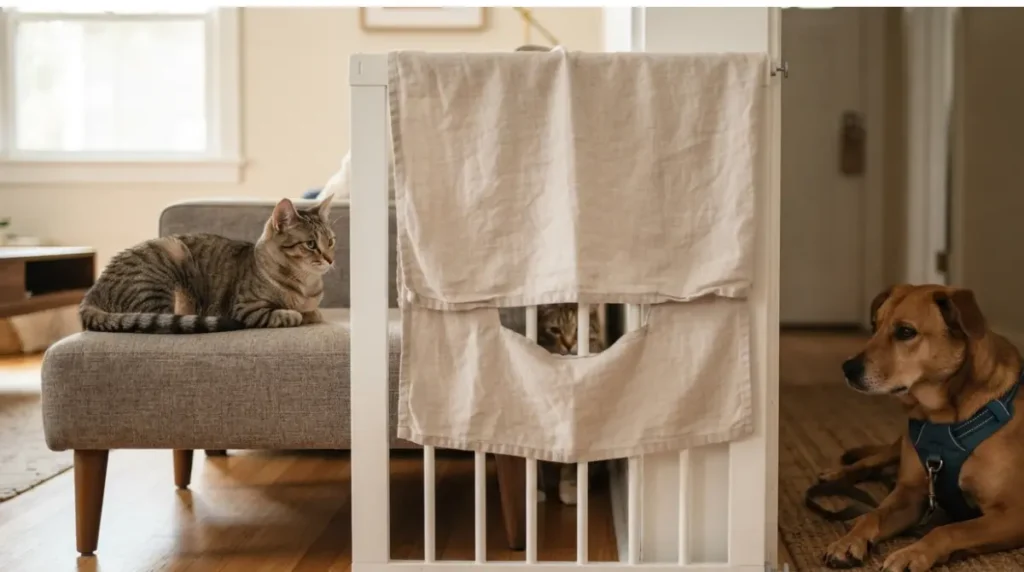
Week 2 adds a little sight.
Use a covered baby gate
Drape a towel over most of a baby gate so they see each other only a little, during calm, positive activities, per International Cat Care.
Read their body language
A relaxed cat has forward ears, normal pupils and a natural tail; flattened ears, wide pupils, a tucked or puffed tail or hissing signal stress, per International Cat Care’s cat communication guide. In the dog, fear or excitement is too much, and staring or stiffening is a cue to pause.
| Go | Hold | |
|---|---|---|
| Cat | Ears forward, relaxed | Flat ears, hissing |
| Dog | Calm, glances away | Staring, stiff |
Back up to Week 1 if either pet stays upset.
Week 3: Short leashed meetings in the same room
Week 3 puts them in one room, briefly.
Set up the room
Your dog wears a harness and lead; your cat has perches or resting spots and can leave whenever she likes, per International Cat Care. For basic cues, see teaching your dog “leave it” and “stay”.
Keep sessions short, and stop if the dog lunges
Keep early sessions brief and positive, add time gradually, and stay for every minute. If the dog lunges or the cat swats, end the session calmly and return to Week 2.
⚠️ Watch Out: Never put your cat in a crate or carrier for these meetings; International Cat Care says a cat should never be crated for them.
Go / Hold / Back up: Week 3
| Go | Hold | Back up |
|---|---|---|
| Several calm, short sessions | Dog strains or stares; cat stays high | Lunge or swat: return to Week 2 |
Week 4: Supervised free time, then the house rules
Week 4 loosens the lead, never the supervision.
Short supervised free time
Gradually allow more time together, with you in the room, as International Cat Care stresses constant supervision.
House rules that keep it safe
- Your cat keeps a dog-free retreat and high perches.
- Her food, water and litter box stay in her space.
- Keep them apart whenever you can’t watch.
- If anything changes, go back a week.
Go: calm, watched time you can extend. Hold: tension, so repeat Week 3. Back up: a chase or injury, so return to Week 3 and call your vet if anyone is hurt.
What to do when your cat or dog isn’t ready
Going back a stage is part of the plan.
Cat hiding or not using the litter box
Hiding while she still eats and uses the box is a reason to hold; see when hiding is a worry. If she stops using the box, call your vet.
Dog still fixated, or progress stalls
Back up a week and keep them apart when you can’t watch. Call your vet if either pet is hurt or your cat stops eating, and ask whether a veterinary behaviorist or certified behavior consultant would help.
Kitten, senior, puppy and multi-cat homes
🐾 Life-Stage Note: Move at the slowest animal’s pace. With a kitten, puppy, senior or unwell cat, check with your vet before starting. With several cats, run the plan one cat at a time.
Cat and dog introduction FAQs
1. How long does introducing a cat to a dog take?
No fixed timeline: move on only when both stay calm. Our plan runs four weeks, but some pairs need longer.
2. Should the dog be leashed at first?
Yes. International Cat Care advises a harness and lead, with the cat free to leave and use perches.
3. Can I leave my cat and dog alone together?
No. Supervise all contact and keep them apart when you can’t watch. If either is hurt, call your vet the same day.
4. Where does the litter box go with a dog?
In the cat’s own space, in a quiet spot with an exit, away from the dog.
5. Is it normal for my cat to hide after the dog arrives?
Some hiding can be stress, but an adult cat off food about 24 hours needs a vet call; kittens under six weeks, about 12.
6. Is dog flea treatment dangerous to cats?
Dog products with permethrin can poison cats, even through a recently treated dog. If she drools, trembles or seizes, call poison control and your vet now.
7. What if my dog keeps chasing the cat?
End the session, go back a week, and separate them when unwatched. If it continues, ask your vet team for behavior support.
8. Is a kitten or adult cat easier to introduce?
Neither is reliably easier; each animal’s reaction sets the pace. For kittens, puppies or seniors, check with your vet first.
Take it at your cat’s pace
Move on only when both pets stay calm, hold when they don’t, and back up when something feels off. Call your vet for any sign in the second section.