Bringing home a second cat? How to introduce two cats

Introducing a second cat: shelters say 3 to 4 days or a week alone in its room; the AAFP says until it stops hiding. Then each stage has a sign to move on.
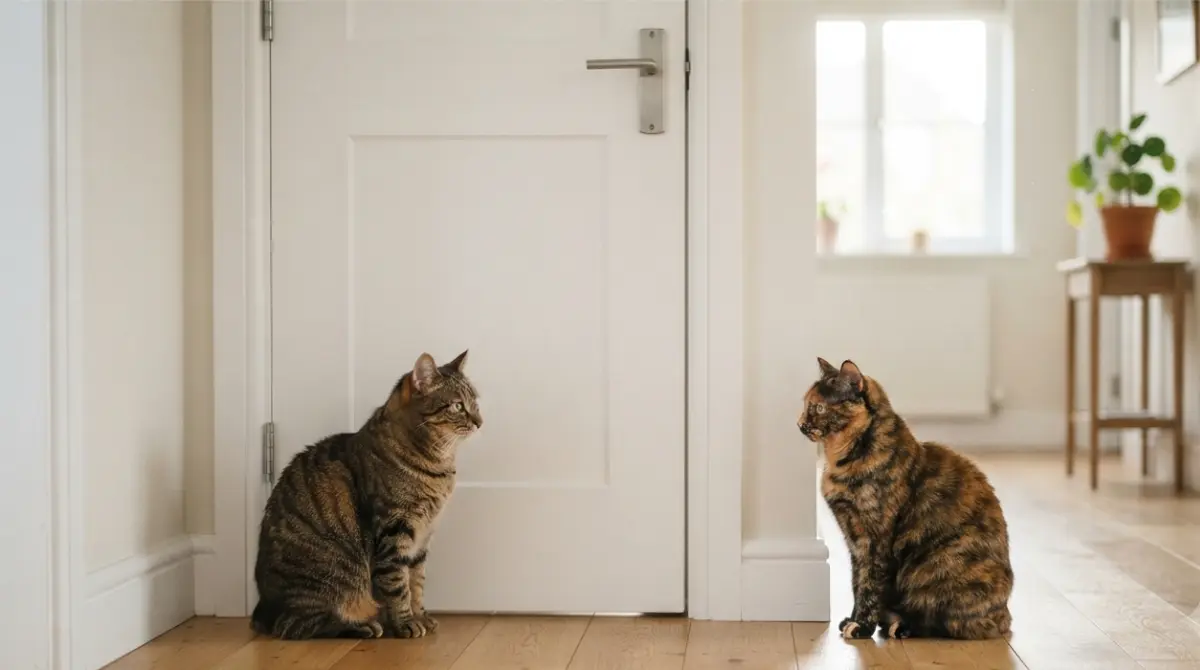
Table of Contents
Introduce two cats in stages, starting with scent, then sight through a barrier, then short supervised visits, and move on only when both cats are relaxed at the stage they’re in. The whole process can take a few days to a few months, and sometimes longer (AAFP step-by-step guide).
The first meeting carries more weight than it seems. In a caregiver survey cited in the 2024 AAFP intercat tension guidelines, 73.3% of respondents said tension between their cats started with the introduction of a new cat.
Is your cat ready for a housemate?
A resident cat who has lived peacefully with other cats has good odds of accepting a newcomer, while one who turns aggressive at the sight of cats outside the window will probably find it hard, PAWS says. Personality outweighs sex, age or size, and the more cats share a home, the more likely conflict becomes (PAWS).
Health matters as much as temperament. Adding a cat is not advised when the one you have is in poor health or is a senior with medical concerns (AAFP).
Adding a kitten to an adult cat’s home
A kitten’s energy can wear on an older or shy cat. The AAFP plan channels it into play, with two or more sessions a day of at least 5 minutes for the high-energy cat, so that energy lands on toys instead of the other cat. Each cat also needs its own hiding spots and elevated perches, which gives the older one somewhere of its own to retreat to (AAFP).
Health checks before the first sniff
Before any introduction, every cat in the home should have had a recent veterinary checkup and be in good health, and your vet should test the newcomer for common contagious diseases (AAFP). Ask at that visit whether it needs feline leukemia virus (FeLV) and feline immunodeficiency virus (FIV) tests, and whether a repeat test later makes sense.
Shelter, rescue or breeder records show the vet which tests and vaccines are already done.
Give the new cat a room your cat doesn’t use
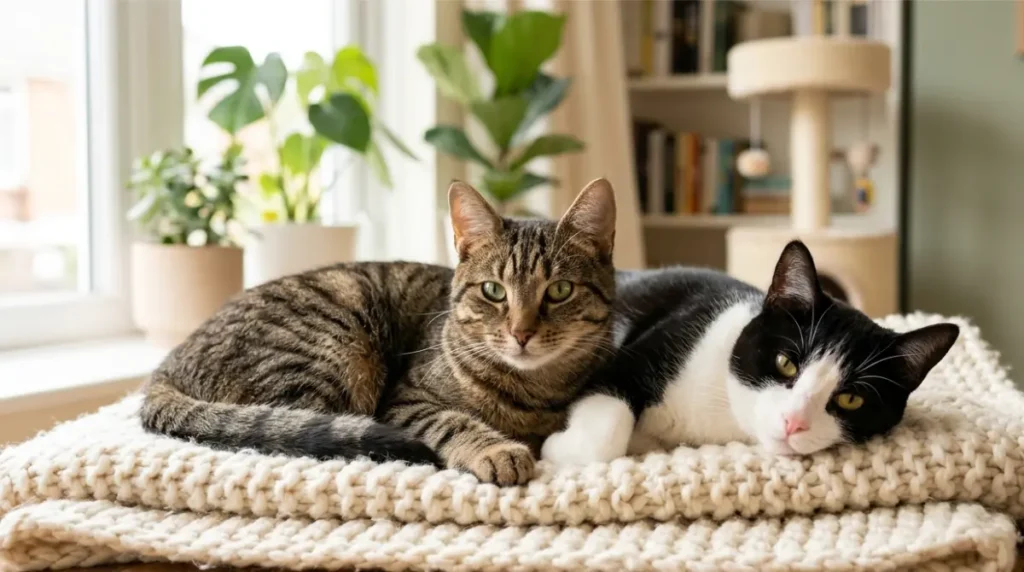
Pick a quiet room away from household traffic, with a door that latches so the cats can’t meet by accident (AAFP). Choose one your resident doesn’t depend on, so its routine stays the same (SF SPCA). Stock it so the newcomer never has to leave:
- food and water bowls and a litter box
- scratching surfaces and a few toys
- a high-sided bed, hiding spots and a cat tree or shelf for height
- the carrier, left open with a towel over it as an extra hiding place
Across the house, plan on one litter box, food bowl, water bowl, bed and scratching post per cat, plus one extra of each, visually separated and spread out (AAFP). For two cats that means three litter boxes, and where you put them matters as much as the count.
On arrival day, carry the newcomer straight to its room in a covered carrier, open the door and let it come out when it’s ready.
Five stages and the sign to move on
Behavior decides when you move on. At every stage, don’t advance until both cats are comfortable with the current one, because pushing ahead can leave long-term tension between them (AAFP). Letting them sort it out early backfires, with problems that take longer to fix and some that never resolve (SF SPCA).
| Stage | What you do | Move on when | Step back if |
|---|---|---|---|
| 1. Settling in | Newcomer stays in its own room | It no longer hides all the time and explores the room confidently | It stays hidden most of the day |
| 2. Scent | Swap bedding or toys daily, then wipe a cloth carrying one cat’s scent over the other’s cheeks and chin | Neither cat reacts to the scent with tension | Hissing, growling, pacing, avoiding the item or missing the litter box |
| 3. Through the door | Meals on each side of the closed door; 5 to 20 minutes of play with two toys tied together, one per side; newcomer explores the house while the resident rests in a favorite room | Both cats eat and play near the door without hissing | Hissing or growling: stop, add distance or a second barrier, try later |
| 4. Seeing each other | Short sessions through a screen door, glass door or extra-tall gate, or a door propped open about 1 inch (2.5 cm) | No intense hissing | Any tension: back to stage 3 for a few more days |
| 5. Same room, supervised | Short sessions with toys and treats, then separate them | They share the room without tension | Chasing, fighting or a fixed stare |
Sources: AAFP, SF SPCA, PAWS.
Shelters and the AAFP put different numbers on the same steps:
| SF SPCA | PAWS | AAFP | |
|---|---|---|---|
| Newcomer alone before the next steps | 3 to 4 days | About a week, if there’s no hissing at the door | No set time; until it stops hiding all the time |
| Supervised sessions | 10 to 15 minutes | Not given | 5 to 20 minutes of play |
| Whole process | Weeks or months before they tolerate each other | 8 to 12 months for most cats to become friends | A few days to a few months, sometimes longer |
Sources: PAWS, SF SPCA, AAFP.
Each cat has to be comfortable before anyone moves on, so the slower of the two sets the pace.
When can they share a room unsupervised?
Ten to fifteen minutes at a time, a few times a day, is enough at first, with the cats going back to their own spaces after each session (SF SPCA). Add a little time each session. Toys help if they stay at least 4 feet (1.2 m) apart, so the cats aren’t competing for one.
Don’t leave them alone together until you’re reasonably sure neither will hurt the other (SF SPCA). Until then, separate them whenever you go out.
In a multi-cat home: introduce each resident to the newcomer one at a time, and let the group mingle only after every one-on-one meeting has gone well (PAWS). Two new cats who are already bonded can share a room and move through the stages together; two who aren’t need separate rooms or separate arrival dates (AAFP).
A hiss through the door vs a stare across the room
Hissing at the door in the first days is common. The SF SPCA holds off on the next step only for intense hissing, meaning loud and open-mouthed with teeth showing, or several hisses in a row (SF SPCA).
Later signs are quieter, which is why tension between cats so often goes unrecognized (AAFP, 2024). Chasing, or a long stare held across the room, counts as tension even when nobody makes a sound (SF SPCA; AAFP). Reading ears, tail and whiskers helps you catch them early. A cat who stops eating or stops using the litter box is under strain too, and if it’s your resident, phone the vet (SF SPCA).
Older advice called for a squirt of water or a firm “no” at a hissing cat. Current guidance is not to discipline a cat for hissing or growling during an introduction (AAFP), and punishment tends to prolong aggression between cats (SF SPCA).
Breaking up a standoff without your hands
Never reach between two tense cats or pick one up. A cat that can’t reach the cat it’s upset with may bite whatever is closest, including your hand (AAFP). Slide a pillow or a sheet of cardboard between them to break eye contact, then steer each one into its own play or its own room.
Go to a vet now if: a cat strains in the litter box and passes little or no urine, especially a male, or either cat has a bite wound or a swelling after a scuffle. A change in the number of animals in a home is one of the stresses linked to urinary problems in cats, and males are at higher risk of a urinary blockage (Cornell Feline Health Center).
Step back a stage, then call your vet
Setbacks are part of the process. When tension appears, return to the last stage where both cats were relaxed and stay there a few more days before trying again (AAFP).
If one cat spends most of its time hiding, or the other keeps harassing it, PAWS advises bringing in a professional, and your vet is the first call. A vet checks for a medical reason first, so note the signs on which behavior changes point to a health problem before the visit. The 2024 AAFP guidelines were written to help vets manage tension between cats, and a referral to a veterinary behaviorist can follow.
Cats who got along for months and then turned on each other need a different approach, set out in what to do when cats suddenly start fighting.
Friendship, when it comes, takes most cats most of a year (PAWS). Many pairs never get close, yet most still adjust to sharing a home (SF SPCA).
If the newcomer isn’t home yet, book checkups for both cats this week and set up the room first. Stage one starts the day the carrier comes home.