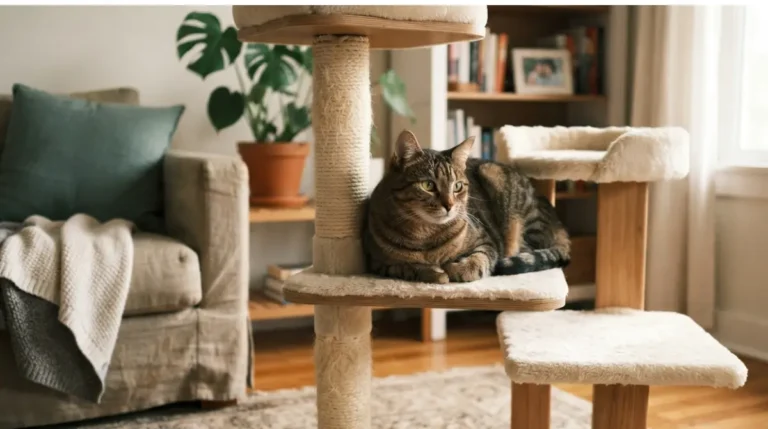
Clicker training cats starts with a nose touch

Clicker training a cat, one session a day: charge the click, teach a nose touch, then a step onto a blanket. Sessions run 30 seconds to 5 minutes.
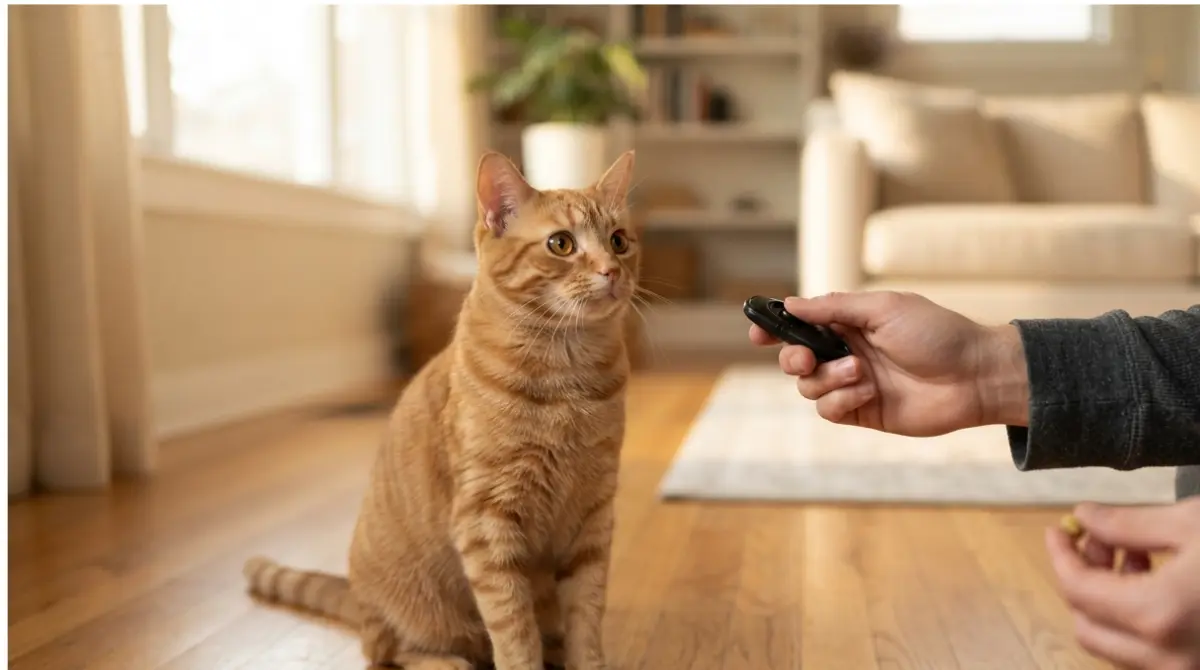
Table of Contents
Clicker training a cat starts with two jobs: teaching her that the click means food, then rewarding her for touching her nose to a target. In a study of 100 shelter cats given 15 five-minute sessions over two weeks, 79% learned that touch on cue, while only 27% learned to sit (Kogan et al., Animals, 2017).
One short session a day is enough to begin. Five of them lay the groundwork for later skills, from a carrier she walks into to a scratching post she picks over the sofa.
What five sessions can teach your cat
Of the four behaviors the study’s trainers taught, the target touch was the one most cats mastered. Sitting on cue was the one the fewest managed.
| Behavior taught | Cats that mastered it | What it means for your first five sessions |
|---|---|---|
| Touching a chopstick or finger with the nose | 79% | Teach it first |
| Spinning in a circle | 60% | Leave it until the touch is solid |
| High-five with a front paw | 31% | Leave it for later too |
| Sitting on cue | 27% | Catch it when she offers it; no word cue yet |
Source: Kogan, Kolus and Schoenfeld-Tacher, Animals, 2017
“Mastered” had a strict meaning in that study: performing the behavior on cue five times in a row. Interest in food made a difference for the touch and the high-five, though not for spinning or sitting.
So these five sessions end with a dependable touch and a sit you catch as it happens. A sit on a spoken word by session 5 asks more than most of the study cats managed in 15.
Check her appetite and treat supply first
Before the clicker comes out, make sure she is eating normally and acting like herself. A vet check before training is worth it, since a cat who feels unwell may struggle to learn (Cats Protection).
Go to a vet now if: your cat has stopped eating. Appetite loss is a sign of many illnesses, including diabetes and kidney disease. It can seriously affect an adult cat’s health if it lasts as little as 24 hours (Cornell Feline Health Center).
If she has also started hiding or skipping the litter box, read about which behavior changes need a vet before you train.
Pick a treat she would leave a sunny windowsill for, one that is quick to eat and needs little chewing. Set a small portion aside before you start. When it runs out, the session is over. Trim her other food that day to match, so the training doesn’t add weight (Cats Protection).
Session length, by source
Shelters and researchers set session length differently, though none of them sets it long.
| Source | Charging the click | Length of one session | Time to a trained behavior |
|---|---|---|---|
| Humane Colorado | Click and treat, five times | As short as 30 seconds | Cats learn at different rates |
| Cats Protection | Repeat until she looks for the treat on hearing it | No set length | A few days to a few months |
| Kogan et al. (100 shelter cats) | Not given as a count | 5 minutes | 15 sessions over two weeks for the results above |
Sources: Humane Colorado, Cats Protection, Kogan et al.
A minute or two suits a cat new to training, with five minutes as the upper end the study used. Stop while she still wants more. If her attention drifts, a short play break followed by an easier repetition can bring her back (Humane Colorado).
Fifteen-minute sessions, a length some pet sites give, run well past anything these three sources describe.
Run the five sessions one a day
Sit on the floor of a quiet room with the clicker in your pocket and the treats within reach but out of her face. Choose a time when she is relaxed but awake and no other pets are around.
| Session | Goal | Move on when | If she stalls |
|---|---|---|---|
| 1 | Charge the click | She looks for a treat as soon as she hears it | Muffle the click; try a better treat |
| 2 | Nose touch | Five straight touches | Hold the target closer to her nose |
| 3 | Follow the target | She steps to reach it | Go back to a shorter distance |
| 4 | Catch a sit | She sits, gets clicked, and sits again soon after | Train where she already sits often |
| 5 | Step onto a blanket | She steps on to reach the target | Hold the target just above the blanket’s edge |
Pass signs for sessions 1 and 2: Cats Protection, Kogan et al.
Session 1, charging the click
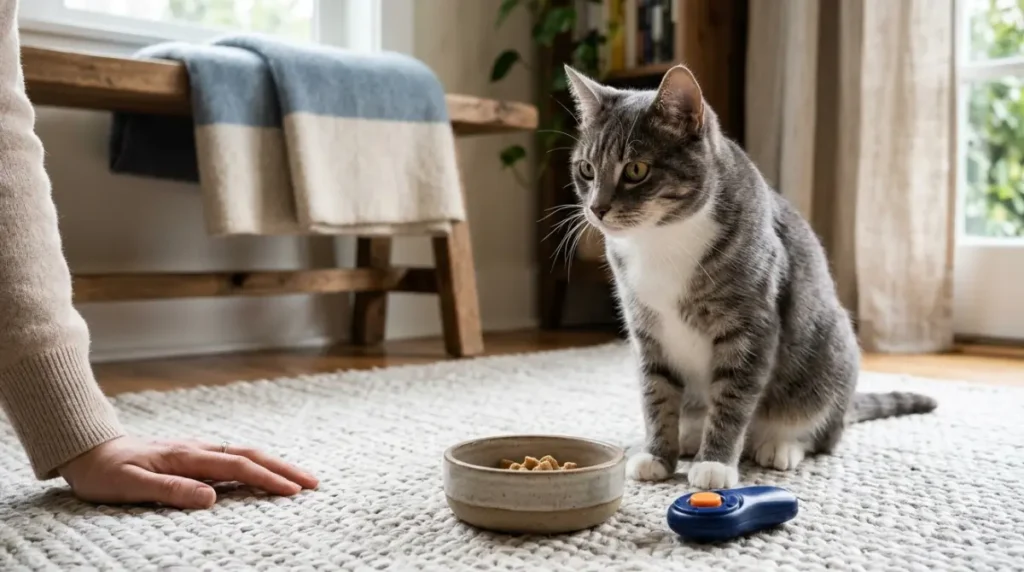
Charging means pairing the click with food until the sound alone tells her a treat is coming. Click, then hand over or toss a treat at once. Humane Colorado repeats the pair five times. Cats Protection keeps going until she turns toward you for the treat as soon as the click sounds.
Hold the clicker away from her face. Up close, some cats find it startling and others fixate on the device itself (Humane Colorado).
Make no other noise with the click. If you click at the wrong moment, hand over the treat anyway so the sound keeps its meaning (Cats Protection).
Your cat’s first nose touch
A chopstick or one finger makes a good target, the same two the study trainers used.
- Hold the target close to her nose and wait.
- The instant her nose touches it, click and treat.
- Take it away, offer it again, and repeat.
She has it when she gives you five straight touches, close to the bar the researchers set for mastery.
How far should the target move?
A few inches at first. Move the target a short distance, click the touch, and stretch the distance bit by bit (Cats Protection). If she stops following, go back to the last distance that worked and build out from there.
Catching a sit she already offers
Wait for it. When she sits on her own, click as her rear meets the floor, then treat.
Marking a behavior she already does is called capturing. It means keeping the clicker and a few treats handy between sessions (Humane Colorado).
Save the word “sit” for later. A spoken cue comes once she offers the behavior readily (Cats Protection).
Session 5 ends on a blanket
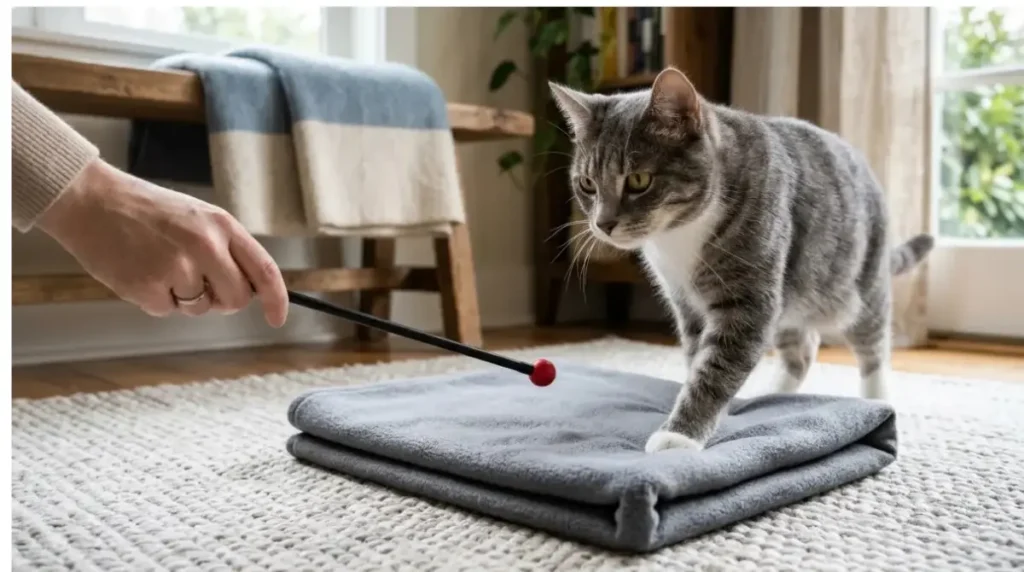
A folded blanket on the floor turns the touch into a place to go. Hold the target just above it so that reaching it means stepping on. Click when her front paws land, and toss the treat onto the blanket.
Kittens, seniors and homes with several cats
Age made no difference to learning in the 100-cat study, and cats can start at any age, with younger ones sometimes responding faster (Cats Protection). Temperament mattered more.
Bolder cats gained more than shy ones (Kogan et al.). A nervous cat may need trust before training, and a socialization timeline for a shy cat is the better place to begin.
In a multi-cat home: train one cat at a time with the others out of the room, since other household pets are among the distractions to avoid while a cat learns (Humane Colorado). If the cats are already tense with each other, start with how to introduce two cats.
In an older cat, watch how she sits. If she lowers herself slowly or stops sitting altogether, drop the sit and stay with the touch. Slow, careful sitting can be a sign of pain, which how to spot pain in a cat covers in detail.
When she walks off or flinches at the click
Most stalls trace back to the reward, the sound or the length of the session.
When she walks off after a few repetitions, shorten the next session and offer a treat she values more. If food never holds her interest, toys or a short game can serve as the reward at the end of a session (Humane Colorado). Ways to get a cat interested in play can show you which kind she likes.
A cat who startles or backs away at the click needs a quieter signal. Muffle the clicker in a pocket or behind your back. If the sound still frightens her, a flashlight blink can mark the moment instead (Humane Colorado).
A spoken word can replace the click, as long as it never changes and you never use it outside training. Saying it without a reward weakens it. The clicker’s advantage is that it sounds identical whoever presses it, which matters when two people train one cat (Cats Protection).
Never punish her for getting it wrong, by voice or with a spray of water. If frustration builds on either side, stop and try again another time (Cats Protection).
A touch that works in the kitchen can seem to vanish in the bedroom. That is common in a cat new to training. Practice in each room of the home is how the behavior comes to travel with her (Humane Colorado).
Next, build the blanket into a carrier
Session 6 can open carrier training. The Cat Friendly Clinic carrier videos break it into six steps:
- settling on a blanket
- an open-top carrier
- a closed carrier with the door off
- the door on
- longer stays
- moving the carrier
Your cat already knows the first one.
Once a behavior holds up on cue, thin the treats to every other repetition and then every fourth (Cats Protection). The same touch can later guide her from the sofa arm to a post, the starting point for moving scratching off your furniture.