Kitten behavior stages from 8 to 16 weeks and what changes

Kitten behavior from 8 to 16 weeks, from ankle ambushes to fading social play, plus the panleukopenia signs that mean a vet visit now.
Table of Contents
Between 8 and 16 weeks, wrestling and pouncing on moving feet are normal kitten behavior, and the biggest changes come late in the window: social play begins to decline at 12 to 14 weeks (AAHA), and baby teeth start falling out at 14 to 16 weeks (EU Platform on Animal Welfare). A kitten who comes home at 8 weeks has already passed the stretch when she learned about people most easily, so these weeks are for building on that and moving her hunting play onto toys.
The household changes the details. A lone kitten with no young cat to wrestle tends to aim that play at people, and a kitten joining an older cat needs a slower start.
The main socialization window closes before 8 weeks
Before she turns 8 weeks, a kitten is in the sensitive period, when she takes in people and the sounds of a home most readily. The EU guidance puts that period at 2 to 7 weeks in its text and 2 to 7 or 8 weeks in its development table (EU guidance). The AAHA behavior guidelines run later. Their table treats 7 to 10 weeks as the last age at which first meetings with people can still readily shape how comfortable a cat becomes with them, with more time needed each day than earlier (AAHA).
So the end date shifts by two or three weeks depending on the source. Neither treats 8 weeks as a cliff.
Older shelter handouts warn that skills missed by 8 weeks may be lost forever. Current guidance describes new experiences becoming harder to accept after the window, and it asks owners to keep handling a kitten positively into adulthood so that what she learned holds.
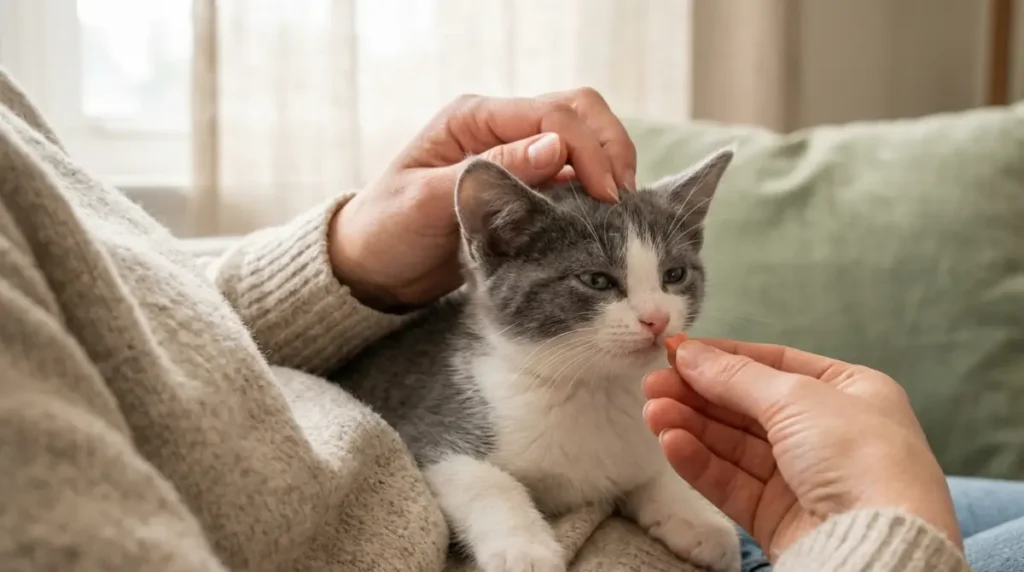
For an 8- to 12-week-old, that means short handling sessions spread through the day, each paired with a treat: a stroke along the head and back, then a quick look at her ears and paws. Watch her while you do it. Stiff legs, flattened ears or squirming free all mean stop. Handling should end when a kitten is distressed, and a frightening experience should not be repeated in the hope that she will get used to it (EU guidance). If she already bolts from visitors, the timeline for socializing a shy cat works at her pace.
What changes from week 8 to week 16
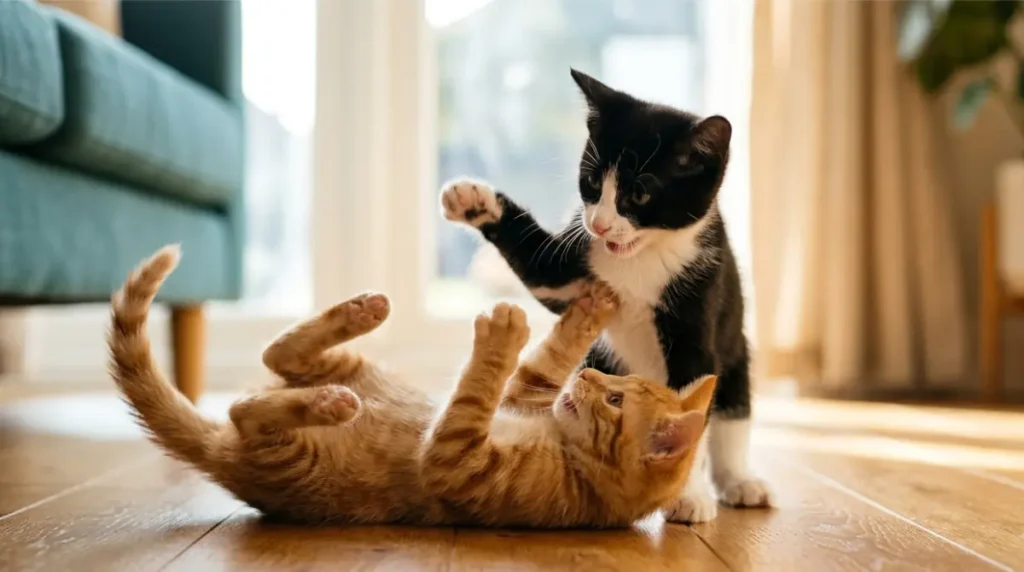
Read each row as a typical age, since timings vary even between littermates, with breed, genetics and sex among the reasons (EU guidance).
| Age | What you’re likely to see | Source |
|---|---|---|
| 6 to 12 weeks | Pouncing, rolling belly-up and standing tall get another kitten to play back 90% of the time | AAHA |
| About 9 weeks | Play with objects increases | AAHA |
| By 12 weeks | Play with other kittens starts to look like hunting and fighting | AAHA |
| 12 to 14 weeks | Social play begins to decline | AAHA |
| 12 to 16 weeks | Males and females start to play differently | AAHA |
| 14 weeks | Social fighting may start | AAHA |
| 14 to 16 weeks | Baby teeth start falling out; all adult teeth are in by 24 weeks | EU guidance |
| From 14 weeks | Play with other kittens declines but matters until 4 to 5 months | EU guidance |
| From about 4 months (17 weeks) | Females may come into heat | EU guidance |
Sources: AAHA 2015 Canine and Feline Behavior Management Guidelines; EU Platform on Animal Welfare guidance on kitten socialization.
The last rows matter most for a 16-week-old. Her baby teeth are coming out while her play moves from wrestling toward hunting. A female can come into heat at about 4 months, which is why it’s worth asking about spaying or neutering at one of her vaccine visits.
Why does my kitten attack my feet?
An ankle ambush from under the couch is hunting practice. By 12 weeks, a kitten’s play with other kittens takes on the patterns of predatory behavior (AAHA). A kitten with no littermate puts those patterns to work on whatever moves. Young cats and kittens raised without littermates, or without enough chances to play, are the ones that most often show play aggression (Cornell Feline Health Center).
Rule out pain before you treat it as play. Dental disease and other medical problems can cause aggression in cats, and a vet check comes before any behavior plan (Cornell). For a kitten this age, mention the biting at the next vaccine appointment.
Timing is where the fix starts. If she ambushes at the same spot or hour, begin a toy session just before, and keep the toy well away from your hands. When she does bite, walk away; ending the game teaches her that rough play stops the fun.
Tapping her nose or a sharp “no” is common older advice. Cornell advises against physically punishing or even touching a cat during play aggression, since she may grow fearful of you or read it as more play. The step-by-step plan for redirecting a kitten who bites hands covers the rest.
In a multi-cat home: introduce the kitten in stages. Start with bedding that carries the other cat’s scent, then let them see each other from a distance, then hold supervised meetings only with a friendly, healthy, vaccinated cat (EU guidance). Give both cats places to retreat. The full sequence is in how to introduce two cats.
Vaccine visits fall every 3 to 4 weeks
Three or four of them, most likely. Core kitten vaccines are repeated every 3 to 4 weeks until 16 to 20 weeks of age (AAHA/AAFP vaccination schedule). Starting at 8 weeks with 4-week spacing, that puts visits at 8, 12 and 16 weeks; with 3-week spacing, at 8, 11, 14 and 17. Your vet sets the actual dates and decides when the series ends.
The antibodies a kitten gets from her mother protect her only for a while, and they affect how many boosters she needs (Cornell). Until the series is finished, ask the vet before she meets cats from outside the home.
Use the weeks between appointments. Leave the carrier open with familiar bedding and a treat inside, and close the door only once she rests in it on her own (EU guidance). Practice the handling a vet will do, looking at her eyes, ears, mouth and paws, and reward her each time.
Signs that are not a phase
If a kitten in this window suddenly stops playing and eating, treat it as illness until a vet says otherwise.
Go to a vet now if: your kitten is vomiting, has diarrhea, seems depressed or lethargic, has stopped eating, looks dehydrated (sunken eyes or dry gums) or seems to have a painful belly. These are signs of feline panleukopenia, a highly contagious virus, and sudden death from it is seen most often in kittens under 5 months (Cornell). Call your vet or the nearest emergency vet, tell them her age and which vaccines she has had, and bring her in a closed carrier.
Hiding without any of those signs is harder to read. Where she hides, for how long, and whether she still eats and uses the litter box all help sort a scare from a problem; when hiding means a vet visit goes through them. For changes at any age, see normal cat behavior and the warning signs that need a vet.
Move every game onto a wand toy
Starting tonight, note when and where she ambushes you, and have a wand toy out a few minutes before that time. Keep the end of the wand moving along the floor so the toy is the target and your hand stays out of reach (Cornell). Put the wand away when play ends, because kittens should not be left alone with fishing-rod toys (EU guidance). Once she chases it reliably, short reward-based sessions can build on that chase; the first five clicker training sessions are a good place to begin.
Settling down and the age to come home
At what age do kittens settle down?
No source gives a single age. Play with other kittens starts to fade from about 14 weeks but stays an important part of learning until 4 to 5 months, and play with objects keeps increasing through that time (EU guidance).
Is 8 weeks too young to bring a kitten home?
Eight weeks is the minimum in the EU guidance, and only once she is fully weaned. Separation before 8 weeks is linked to a higher risk of aggression in adulthood, and delaying weaning past 12 weeks may lower the chance of anxious or repetitive behavior later (EU guidance).