Cat Behaviorist Cost Made Simple, From Consult to Specialist

Cat behaviorist cost depends on who you hire: Cornell lists $115, while veterinary behaviorists we checked start near $580.

Table of Contents
The short answer: what a cat behaviorist costs
A first visit runs from about $115 at a university service to roughly $580–$990 with a veterinary behavior specialist, and certified consultants fall in between (fees as published, retrieved October 1, 2026). The cat behaviorist cost spread is wide because the word covers four different jobs.
🚨 Go to a Vet Now If: your cat strains in the litter box and passes little or no urine, cries out, or grows more distressed, especially a male cat. The AVMA calls a urinary blockage an emergency that needs immediate veterinary care. Go to an emergency clinic now; don’t wait for a behavior consult.
Not an emergency? If you can’t tell behavior from health, start with normal cat behavior versus vet warning signs. If you’ve decided to get help, here’s what each type costs.
ℹ️ Vet Note: This article explains what behavior help costs; it isn’t a diagnosis. Behavior changes often have a medical cause, so a veterinary exam usually comes first, and any medication question belongs with your veterinarian.
Four kinds of cat behavior help, four price tiers

No governing body regulates who may call themselves a behavior consultant (per AVSAB), so the price depends on who you hire.
The Price Ladder
| Tier | What you get | Published fee (retrieved Oct 1, 2026) | Best for |
|---|---|---|---|
| Your regular vet | Exam, history, first-line advice | Set by your clinic; ask for an estimate | Any sudden change; always first |
| University consult | Veterinary behaviorist reviews your history form | $115 (Cornell’s Camuti service) | Lower-cost guidance |
| Certified consultant (not a vet) | Behavior plan with follow-up | $250 online consult with a month of email/text support (Allison Helps Cats); $450 program: 90-minute first session, three follow-ups, six months of review (The Cat Behavior Clinic) | A guided plan once medical causes are ruled out |
| Board-certified veterinary behaviorist | Veterinarian with specialty training | $605, 90 minutes (Tufts’ behavior service); $595 incl. follow-up care (SF SPCA); $580–$685 (Veterinary Behavior Consultations); $990 for up to 3 hours (Veterinary Behavior Consultants, San Diego) | Severe or complex cases; medication questions |
📊 Tested / Sourced: Each figure is that provider’s published fee on October 1, 2026, and fees change. We found only two certified-consultant pages with clear published prices, so treat that row as examples, not an average.
Behaviorist vs veterinary behaviorist: who does what
A veterinary behaviorist is a veterinarian with advanced specialty training, certified by the American College of Veterinary Behaviorists (DACVB), who evaluates the medical, emotional and environmental factors behind a problem. A certified consultant coaches a behavior plan but isn’t a vet, so medication questions stay with your veterinarian.
Why quotes for the same problem vary so much
Four things move the price: who you hire, format, bundled follow-ups, and how many cats are involved.
Format, location and package pricing
One consultant adds $125 for an in-home visit on top of her $250 online consult, while a veterinary behavior practice lists remote consultations at $500 versus $580–$685 for its standard one. So video visits can cost less, but compare what each fee includes, not just the headline number.
Kitten, senior and multi-cat households
Tufts asks that fighting pets both attend, and one virtual service requires referrals for both pets in household aggression cases, so a two-cat conflict can cost more. For sudden fights, see our guide to cats fighting suddenly and how to reintroduce them.
🐾 Life-Stage Note: Senior cats: age-related illness can affect whether a cat reaches the litter box, so the vet exam usually comes first. We found no published price difference for kittens.
The vet exam you’ll likely pay for first
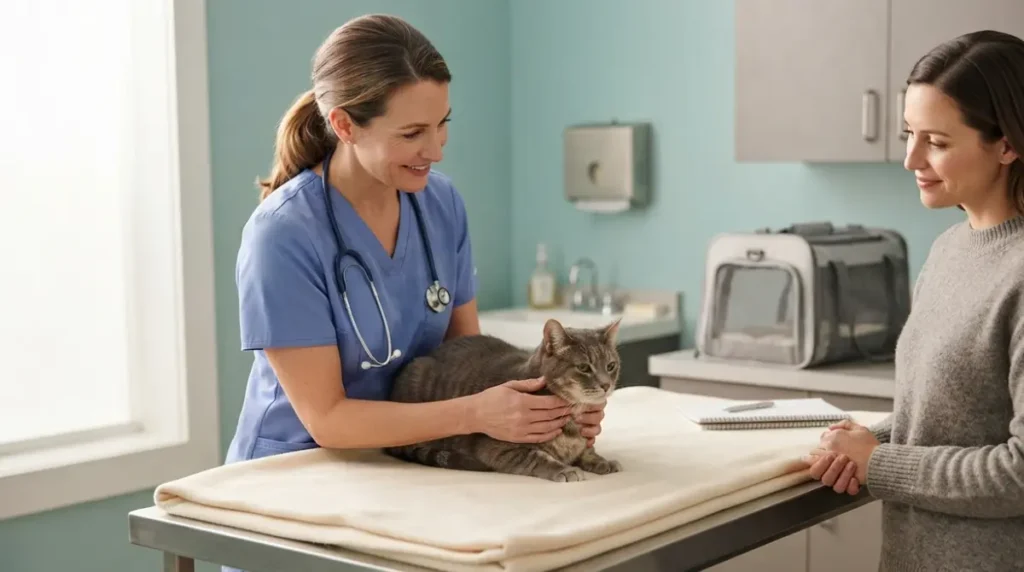
Yes, see your vet before you book behavior help. Cornell’s Feline Health Center advises a thorough exam and diagnostic tests for a cat soiling the house, and notes that cats with medical problems don’t always act sick.
Why behavior changes need a vet check first
Litter box trouble can come from urinary tract inflammation, kidney or thyroid disease, diabetes, digestive problems, or age-related disease. The AVMA adds that stress and multi-cat living can raise the risk of urinary disease, so behavior and health overlap. If your cat is peeing outside the litter box, start here.
What the visit may involve
- Questions about your cat and home, plus a physical exam.
- For urinary signs, usually a urine test.
- If the cause isn’t clear, cultures, imaging or bloodwork.
Ask for a written estimate first, because cost depends on the tests your vet chooses. If medication comes up, Cornell notes it works only alongside environmental changes and needs a veterinarian’s monitoring. Unsure it’s urgent? See behavior changes that mean a vet visit.
✅ Do This: Before the visit, note when the change started, how often it happens, and any change in eating, drinking or litter habits, and bring a short video. Ask: “Would you refer us to a veterinary behaviorist?”
What your money buys in a first session
A first session is mostly history-taking and planning, not a quick fix.
What happens, step by step
- History: you complete an intake form first. Cornell sends a behavioral history form, and another consultant reviews your submitted paperwork.
- Discussion and observation: Tufts’ 90-minute visit covers your pet’s behavior and overall health, with observation.
- Plan: you leave with recommendations, and Tufts includes an estimate of follow-ups.
- Follow-up: three 30-minute visits, a month of email or text support, or one Cornell follow-up on request.
How many sessions to expect
No one can promise a number; it depends on how complex the problem is. The programs we checked bundle one to three follow-ups or a month of support.
Cheaper steps to try before (or alongside) booking
Money is a real limit, and there are lower-cost routes, though none replaces the vet exam.
Low-cost first moves
- University consult: Cornell’s Camuti service charges $115 for a behavior consultation.
- Vet-to-vet consult: the SF SPCA’s behaviorist consults directly with your own vet, from $150. Ask your clinic whether something similar exists near you.
- Vouchers: one certified consultant offers income-based vouchers for qualifying clients.
- Home setup: check how many litter boxes your household needs before paying for advice on it.
Insurance and payment questions
Coverage for behavior care differs from plan to plan. Read your policy’s behavior-care wording and ask your insurer before you book.
How to spot a good behavior consultant before you pay
Anyone can say “cat behaviorist,” so the credential and the questions matter.
What the credentials mean
IAABC-certified consultants need three or more years of consulting experience with complex cases. A board-certified veterinary behaviorist is a veterinarian with advanced specialty certification. Neither replaces your cat’s own vet exam.
Red flags before you book
- Never asks whether your cat has seen a vet.
- Offers to diagnose a medical problem or advise on medication, which is your vet’s job.
- Relies on punishment: Cornell says hitting, kicking or screaming is ineffective and the anxiety may worsen soiling.
- Promises guaranteed results, or can’t say what the fee includes.
Cat behaviorist cost: common questions
1. How much does a cat behaviorist cost?
About $115 at a university service, $250–$450 for the certified consultant programs we checked, and roughly $580–$990 for a veterinary behaviorist’s first visit.
2. What’s the difference between a cat behaviorist and a veterinary behaviorist?
A veterinary behaviorist is a veterinarian with specialty board certification; a certified consultant builds behavior plans but isn’t a vet. “Behaviorist” alone isn’t regulated.
3. Does pet insurance cover a cat behaviorist?
Coverage differs by plan. Read your policy’s behavior-care wording and ask your insurer before booking.
4. Is a virtual consultation cheaper?
Sometimes. Two providers we checked price video visits below in-person ones, so compare each provider’s published fees.
5. Should I see my vet first?
Yes. Medical problems can cause litter box and behavior changes, and cats don’t always act sick. Straining with little or no urine is an emergency.
6. How many sessions will my cat need?
It depends on how complex the problem is. The programs we checked include roughly one to three follow-ups.
7. How can I lower the cost?
Start with your vet, try a university consult like Cornell’s, ask about a vet-to-vet consultation, and check your insurance wording.
8. Is peeing outside the box a behavior problem?
Not always. It can signal a medical problem, so see your vet. Straining with little or no urine, especially in a male cat, is an emergency.
Your next step
Start with your vet, then match the problem to a tier: a university consult for guidance, a certified consultant for a behavior plan, or a veterinary behaviorist for complex cases. Ask what the fee includes before you book. If you’re still unsure whether it’s behavior or health, our guide to normal cat behavior and vet warning signs is the place to begin.