Why Is My Maine Coon Kitten Wobbly? Check Urgent Signs First

A Maine Coon kitten wobbly on its back legs is scary. Learn why when it started matters, and what to bring to your vet visit.

Table of Contents
My Maine Coon kitten is wobbly: what to check first
A Maine Coon kitten wobbly on its back legs is frightening. How fast it started matters most.
Check for emergency signs first
🚨 Go to a Vet Now If: Your kitten suddenly can’t use its back legs, cries out in pain, has cold or pale back paws, breathes with its mouth open, collapses, or is limp, cold and won’t eat. Call ahead.
- Sudden change: read the emergency section below.
- Since first steps, or from 3 to 4 months: read the SMA sections.
ℹ️ Vet Note: This is general education, not a diagnosis. Any wobble needs a vet visit.
When a wobbly kitten needs an emergency vet now
Sudden back-leg loss, pain or cold paws
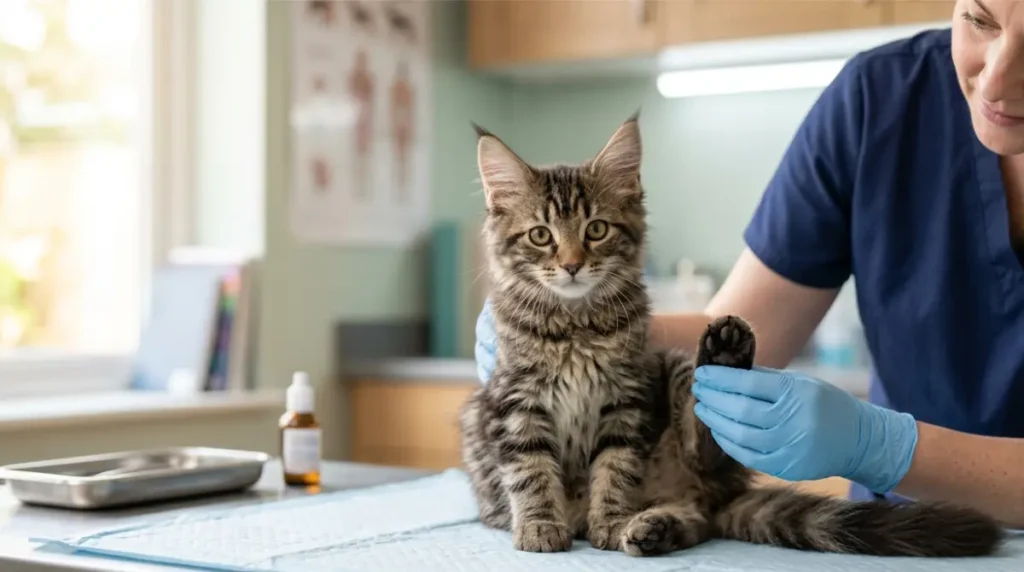
🚨 Go to a Vet Now If: Your kitten drags its back legs, cries out in pain, or has pale or purple, cold back paws.
The Merck Veterinary Manual says a clot can cut blood flow to the hind limbs. See our Maine Coon emergency checklist.
🐾 Life-Stage Note: Cornell says hypertrophic cardiomyopathy (HCM) has been diagnosed in cats as young as 4 months.
A kitten that is limp, cold or won’t eat
A weak, limp or cold kitten that won’t eat needs a vet now. Call ahead; don’t give food or medicine unless the clinic says to.
✅ Do This: Tell the clinic when the wobble started, which legs, and how the paws feel.
What SMA looks like in a Maine Coon kitten
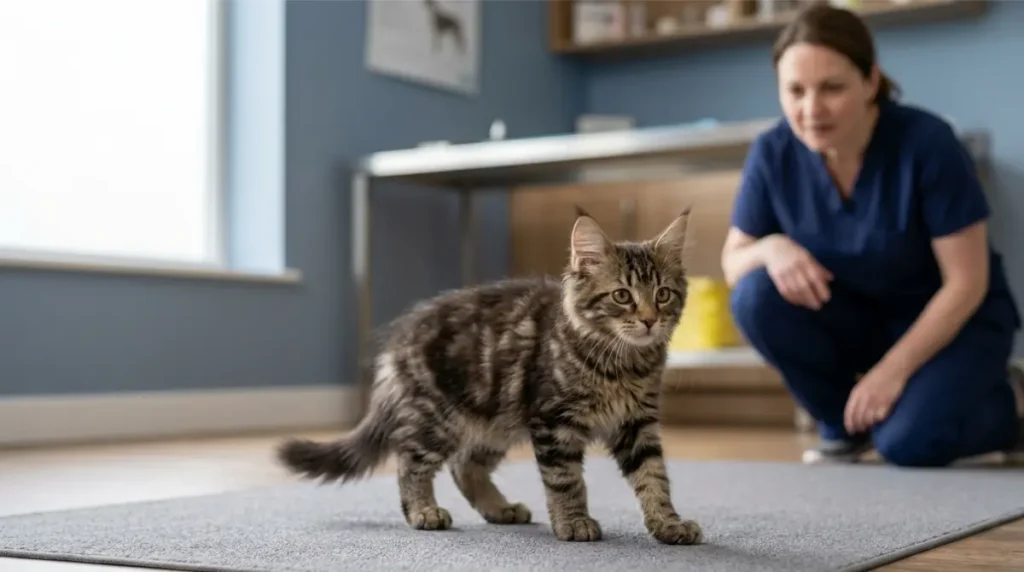
Spinal muscular atrophy (SMA) is inherited, and UC Davis says affected kittens first show signs at about 3 to 4 months.
What you may see in the hind legs
SMA damages motor neurons in the lower spinal cord. UC Davis lists an unsteady walk, odd posture and shrinking hind-leg muscles. Only a vet can confirm SMA.
Is SMA painful or fatal?
UC Davis calls SMA neither painful nor fatal, and affected cats can live comfortably indoors. It is still disabling, so ask your vet to follow it.
SMA or wobbly cat syndrome: how the timing differs
The wobbly kitten timing table
| When it started | What it can point to | What to do |
|---|---|---|
| Suddenly, in a steady kitten | A cause needing an exam now | Call a vet now |
| Since its first steps | Wobbly cat syndrome; not progressive | Vet visit |
| Around 3 to 4 months | SMA; a vet should follow it | Vet visit; ask about the SMA test |
| Hesitating before jumps, or limping | A joint or hip problem | Vet visit; X-rays confirm |
| An occasional clumsy landing | Not enough to judge | Film it; mention it at the next visit |
Sources: UC Davis, Merck, Texas A&M. No source separates normal clumsiness from early signs.
What is wobbly cat syndrome?
🔍 Why Cats Do This: The cerebellum controls balance. Cornell says a pregnant cat’s infection can leave kittens’ cerebellum underdeveloped.
Cerebellar hypoplasia is present from birth and not progressive, says Merck. MRI can confirm it in a living cat.
Is clumsiness normal in a Maine Coon kitten?
Maine Coons mature slowly, per our weight guide, but an unsteady walk deserves a vet visit.
Other causes only a vet can sort out
Texas A&M says a suddenly wobbly cat should be examined by a vet. Joint pain can be subtle; see how cats show pain.
Making home easier for a kitten with wobbly back legs
A low-entry litter box
AAHA says box edges shouldn’t be too high for a kitten to enter easily. For wobbly cat syndrome, Cornell suggests a wide, low entrance. See our litter box guide.
Keep a wobbly kitten indoors
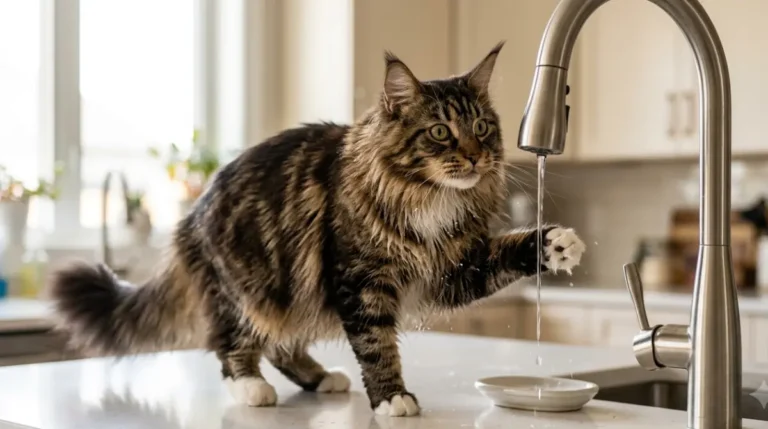
For wobbly cat syndrome, Cornell recommends strictly indoor life, padding, limited stairs and high places, and wide, shallow bowls.
More than one cat or floor
AAHA advises boxes in different, easy-to-reach places, so put one on each floor.
✅ Do This: Ask your vet what climbing and jumping is safe until the exam.
SMA DNA testing: what a result tells you and the breeder
What the test tells you
UC Davis offers a cheek-swab DNA test. N/N means no SMA and S/S means affected. Ask your vet whether to run it.
What a clear result does not rule out
A clear result rules out SMA only. A 2022 Journal of Veterinary Internal Medicine report describes one SMA-negative Maine Coon with progressive weakness. Stay in touch with your vet.
What to ask the breeder
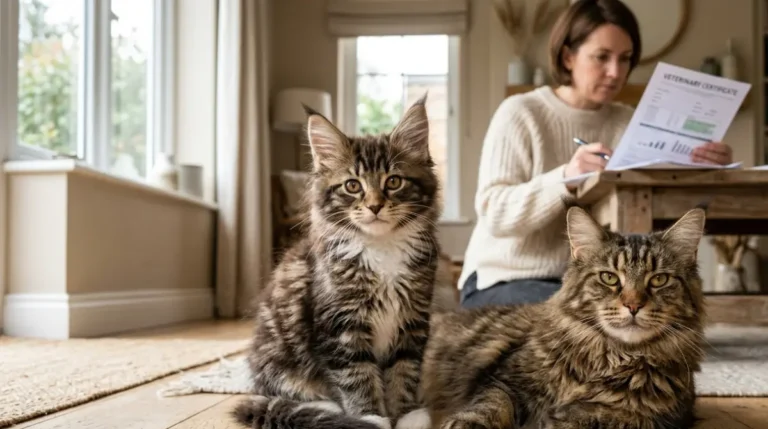
Ask for both parents’ SMA certificates and report signs promptly. See what real breeder paperwork looks like.
What your vet will check for a wobbly kitten
What to film and bring
✅ Do This: Bring a short video of your kitten walking and jumping, the date you first noticed it, the breeder’s records and your weekly weight log.
What the vet may check
The vet may watch how your kitten moves and suggest an SMA DNA test or X-rays.
Questions worth asking
Is it getting worse? Should we run the SMA test?
Frequently asked questions
1. Why is my Maine Coon kitten wobbly?
SMA from about 3 to 4 months or wobbly cat syndrome from its first steps. Sudden onset needs a vet now.
2. At what age do Maine Coon kittens show SMA?
UC Davis says affected kittens first show signs at about 3 to 4 months of age.
3. Is SMA painful or fatal in Maine Coons?
UC Davis calls it neither painful nor fatal, though it can be disabling.
4. Is a wobbly kitten always SMA?
No. Wobbly cat syndrome and other causes exist. A vet decides, and the SMA DNA test can rule SMA in or out.
5. Is clumsiness normal in a Maine Coon kitten?
Maine Coons mature slowly, but an unsteady walk or shrinking hind-leg muscles deserve a vet visit.
6. Can I test my kitten for SMA?
Yes. UC Davis offers a cheek-swab DNA test; ask your vet whether to run it.
7. Should a wobbly kitten use a different litter box?
AAHA says box edges shouldn’t be too high for a kitten to enter easily, so choose a low-entry box.
8. When is a wobbly kitten an emergency?
Sudden back-leg loss, pain, cold or pale paws, open-mouth breathing, collapse, or a limp, cold kitten that won’t eat. Go now.
Your next step for a wobbly Maine Coon kitten
If any emergency sign fits, go to an emergency vet now. Otherwise, film your kitten walking, book a vet visit soon, and ask about the SMA test.