A Smart Owner’s Guide to Maine Coon Size, Cost and Health

Maine Coon size keeps changing: the CFA says they take up to three years to reach full size. See what to expect, what it costs and when to call a vet.
Table of Contents
Maine Coon size, cost and health: what to know first
This guide gives you the size, cost and health picture for a Maine Coon, one life stage at a time, and puts the emergencies first.
Start here if your Maine Coon is unwell right now
🚨 Go to a Vet Now If: Your cat suddenly can’t use its back legs or cries out in pain. Its back paws feel cold or look pale or bluish. It is breathing with its mouth open or struggling for breath. It collapses. Call an emergency veterinary clinic on the way.
Not sure which part you need?
- Your cat seems unwell: read the emergency section next, then call your vet.
- You’re thinking of buying: go to size, cost and the breeder checklist.
- You just brought home a kitten: read growth, the inherited conditions to know, and the first vet visits.
- Your cat is a senior, or heading there: use the age-by-age risk table and visit schedule.
What this guide covers and how it was made
Most Maine Coons live without a crisis, but two problems are time-critical and a few early decisions change the odds.
ℹ️ Vet Note: This guide explains Maine Coon size, costs and breed-linked health risks. It isn’t a diagnosis or a substitute for veterinary care. If your cat has sudden back-leg weakness or pain, cold or pale back paws, open-mouth or labored breathing, or collapses, go to an emergency vet now.
When a Maine Coon needs an emergency vet right now
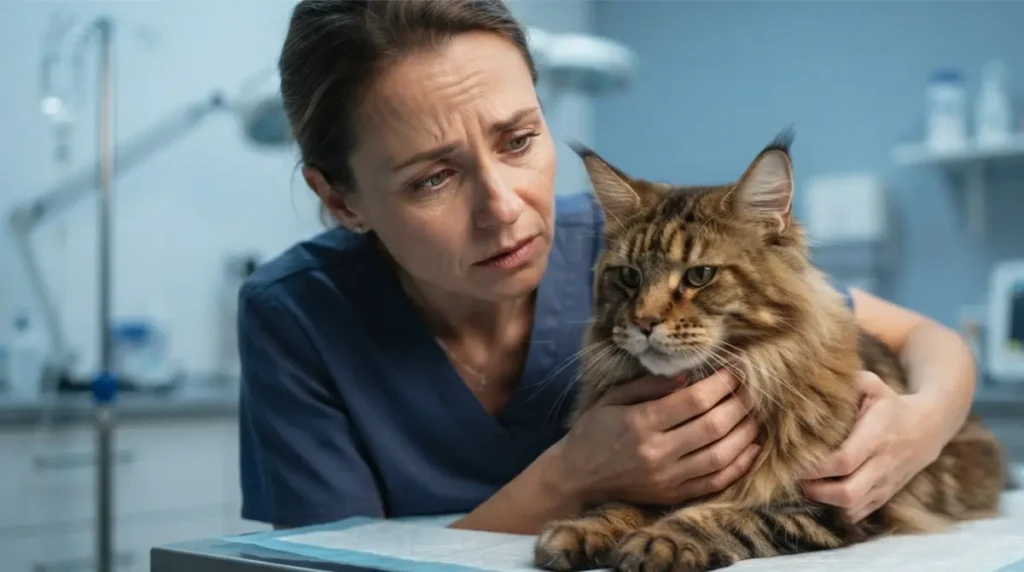
Maine Coons are predisposed to heart disease, and two of its complications are emergencies that need a clinic, not a wait-and-see night.
Sudden back-leg weakness, pain or cold paws
🚨 Go to a Vet Now If: Sudden back-leg weakness or paralysis, especially with severe pain, is an emergency. Signs that a clot may be blocking blood flow to the back legs:
- Your cat drags or can’t use one or both back legs.
- It cries out or seems in extreme pain.
- The back legs feel cold, and the paw pads look pale or purple.
- It can often still move its front legs, and its tail may move normally.
The MSD Veterinary Manual explains how vets recognize a blood clot in cats, and notes that other problems can look similar. Only the clinic can tell which one it is.
🔍 Why Cats Do This: In some cats with heart disease, an enlarged chamber lets blood slow and clot. A clot that breaks loose usually lodges where the main artery splits toward the back legs and cuts off blood flow. That explains the sudden pain, the cold limbs and the pale or purple pads.
Fast or open-mouth breathing, weakness or collapse
Cornell’s overview of feline heart disease calls fast or labored breathing and sudden paralysis emergencies. Many cats with hypertrophic cardiomyopathy look healthy until a crisis, and cats with cardiomyopathy are at risk of sudden death.
If you can do it without delaying care, count your resting cat’s breaths for 30 seconds and double the number. Cornell says more than about 35 a minute suggests extra effort, so call now.
Tiredness or eating less can also be early signs. Call your vet the same day if you notice them.
What to tell the emergency clinic
✅ Do This: Call ahead. Tell them your cat is a Maine Coon, when the problem started, which legs or what breathing you’re seeing, and any heart diagnosis or DNA result you know about. Don’t give any medication unless the clinic tells you to.
How big do Maine Coons get? Size and weight by age
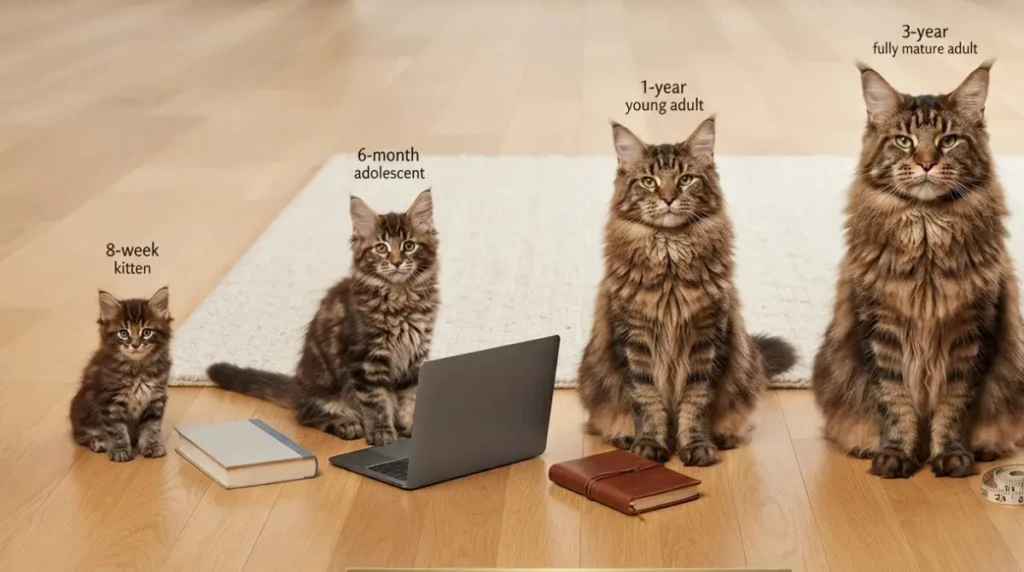
Maine Coons are one of the largest pedigreed cats. The Cat Fanciers’ Association says adult males can reach or exceed 20 pounds and females are usually smaller. Breed guides commonly list roughly 13 to 25 pounds for males and 9 to 15 for females.
📊 Tested / Sourced: The CFA’s breed profile says Maine Coons are slow to mature, taking up to three years to reach full size. The weight ranges above come from published breed guides, not a registry standard, so treat them as ranges, not targets.
Maine Coon weight by age
| Life stage | What to expect |
|---|---|
| Kitten (birth to 1 year) | Fast, steady weight gain. |
| Young adult (1 to 6 years) | Still filling out until about age three, then steady. |
| Mature adult (7 to 10 years) | Stable weight; unexplained loss or gain is worth a vet visit. |
| Senior (over 10 years) | Unexplained weight loss is a reason to call your vet. |
When do Maine Coons stop growing?
Most reach full size by about three years, according to the CFA, and some breed descriptions allow up to five.
🐾 Life-Stage Note: For a kitten, steady gain on your own scale tells you more than matching a chart. A kitten that loses weight or stops gaining needs a call to the vet.
Male vs female Maine Coon size
Males are bigger, so compare your cat with the same sex.
When a kitten’s growth is worth a vet call
Call your vet if your kitten loses weight, stops gaining over several weekly weigh-ins, eats less than usual or seems tired.
✅ Do This: Weigh your kitten weekly on the same scale at the same time, write it down, and bring the log to the vet.
Is my Maine Coon overweight? Body condition and feeding
Big is not the same as overweight, and a Maine Coon’s size makes extra weight easy to miss.
Why a long coat hides extra weight
A thick coat can hide ribs, waist and belly, so a cat can look “just fluffy” while carrying extra body fat. AAHA/AAFP guidance for young adult cats notes that free-choice feeding often leads to overeating and that neutering raises obesity risk, especially in males.
🐾 Life-Stage Note: Young adults (1 to 6 years) are where AAHA/AAFP focus on preventing weight gain. Ask your vet to track weight from the first adult visit.
How to check body condition at home
Vets score cats on a 9-point scale. AAHA/AAFP count 6 or 7 as overweight and 8 or 9 as obese. At home, look from above for a waist behind the ribs, and run your hands along the ribs, which you should be able to feel without pressing hard.
💡 Pro Tip: AAHA/AAFP say vets can record top-down and side photos of body shape. Take your own once a month so you can compare.
Feeding a big cat without guessing
Don’t just cut portions of regular food. AAHA/AAFP warn that feeding less of a maintenance diet can leave vitamin and mineral gaps, and they recommend prescription weight-loss diets for obesity. Ask your vet to score your cat’s condition and set a plan.
⚠️ Watch Out: Extra weight strains joints, and AAHA lists lameness among its consequences, which matters for a breed prone to hip dysplasia. Any weight loss should be gradual and vet-guided.
Maine Coon health risks at every age, from kitten to senior
Being predisposed to a condition doesn’t mean your cat has it, and AAHA/AAFP note that breed-linked conditions aren’t limited to one breed.
Heart disease (HCM) in Maine Coons
Hypertrophic cardiomyopathy (HCM) thickens the heart wall. Cornell calls it the most common feline heart muscle disease, affecting up to 15% of cats, and lists Maine Coons among predisposed breeds. Many cats look healthy early on.
🔍 Why Cats Do This: In HCM, the wall of the heart’s main pumping chamber thickens, so the chamber fills poorly. The upper chamber can enlarge, and fluid can back up into the lungs, which is congestive heart failure.
Echocardiography, a heart ultrasound, is the gold standard for diagnosis. A stethoscope can miss disease, and Cornell notes about one in five cats with a murmur has no heart disease. In a ten-year international study Cornell summarizes, roughly 30% of cats with HCM developed heart failure, blood clots or both.
Spinal muscular atrophy in kittens
Spinal muscular atrophy (SMA) is inherited. UC Davis says affected kittens usually show signs around three to four months, with an unsteady walk and shrinking hind-leg muscles. It describes the condition as not fatal.
✅ Do This: If your kitten looks wobbly behind at that age, film the walk and book a vet visit.
Hip dysplasia and joint pain
A peer-reviewed analysis of 5,038 Maine Coons screened through Sweden’s PawPeds program (2000 to mid-2019) found hip dysplasia in 37.4%. An earlier study of 2,548 cats found 24.9%. These are screened pedigreed cats, so the figures may not match every pet.
Watch for hesitating before jumps, less play and limping. Vets confirm hip dysplasia with X-rays. Our guide to how cats show pain covers joint pain signs.
What to watch at each life stage
| Life stage | What to watch | Vet visits |
|---|---|---|
| Kitten (birth to 1) | Steady gain; wobbly hind legs at 3 to 4 months | Ask your vet for a kitten schedule |
| Young adult (1 to 6) | Weight creep; ask about heart screening | At least yearly |
| Mature adult (7 to 10) | Early kidney checks; joint pain | At least yearly |
| Senior (over 10) | Pain, weight loss, kidney changes | At least every 6 months |
🐾 Life-Stage Note: The AAFP says some cats are best treated as senior from about eight, and sooner for some breeds.
How long do Maine Coons live?
Breed guides commonly cite 10 to 15 years, and the UK’s Governing Council of the Cat Fancy uses that range. Other guides land nearer 13. We found no large lifespan study specific to Maine Coons, so treat these as estimates, not promises.
How much does a Maine Coon cost? Price, yearly and lifetime
Published kitten prices for Maine Coons run from about $800 to $5,000, depending on the source, bloodline and what’s included. Yearly costs are commonly estimated at $1,400 to $3,500. Every figure here is a published estimate as of October 2026, so check it against local quotes.
Maine Coon kitten price: breeder vs adoption
| Item | Published range | Key detail |
|---|---|---|
| Kitten from a breeder | $800 to $5,000 | Ask what’s included |
| Adult cat | $400 to $1,200 | One price guide |
| DNA test (HCM or SMA) | $47 each | UC Davis, per test |
Purebreds are uncommon in shelters, but breed-specific rescues and local groups occasionally have Maine Coons. Ask any seller whether the price covers vaccines, spay or neuter, health testing and registration.
First-year setup costs for a big cat
Published guides put setup at about $300 to $600, mostly for oversized gear. Our litter box guide recommends a box at least 1.5 times your cat’s length, and our scratching post guide covers sturdy options for big cats.
Yearly costs: food, vet care, grooming, insurance
| Cost | Published estimate | Key detail |
|---|---|---|
| Food, per month | $40 to $200+ | Sources differ widely |
| All yearly costs | $1,400 to $3,500 | One planning figure is $2,200 |
| Professional grooming | $30 to $70 a session | Long coat |
Insurance has no reliable price range we could source, so see the care section below.
Lifetime cost and the costs people miss
Calculators that model 14 years with 3.5% yearly inflation land near $30,800. Use that as a planning figure, not a quote.
Two costs are easy to miss. A heart scan (echocardiogram) and emergency care can each be large, and we found no reliable published price.
🐾 Life-Stage Note: AAHA/AAFP call for senior cats to be seen at least every six months, so plan for more check-ups after age 10.
Why the prices you see online disagree
Most figures come from breeder sites and calculators, not receipts. Prices also shift with region, bloodline, date and what’s bundled in. We didn’t find a registry-grade source for Maine Coon prices.
How to pick a healthy Maine Coon kitten and breeder
A responsible Maine Coon breeder can show you health test results, and knowing what they mean protects the kitten and you.
What health tests a good breeder can show
The CFA says breeders test for hip dysplasia by X-ray and for hypertrophic cardiomyopathy using DNA tests and echocardiograms. SMA also has a DNA test. Ask to see the paperwork for both parents.
What HCM and SMA test results mean
| Result | HCM (A31P) test | SMA test |
|---|---|---|
| No copies | Lower risk; doesn’t rule out HCM | Not affected, not a carrier |
| One copy | About 1.8 times the HCM risk | Carrier; passes it to about half its kittens |
| Two copies | About 18 times the risk; highest risk of sudden death | Affected |
Source: UC Davis Veterinary Genetics Laboratory. Its HCM test page says the test can’t rule out HCM and that severe disease can cause sudden death by about age four. Two carriers can produce affected kittens about 25% of the time.
A clear DNA result doesn’t clear the heart. Echocardiography is still the standard check.
Questions to ask before paying a deposit
- Can I see both parents’ DNA and heart-scan results?
- Can I see hip X-ray results?
- What does the price include: vaccines, spay or neuter, registration?
- What does the written health guarantee cover?
- Can I meet the parents and see where the kittens are raised?
✅ Do This: Ask your own vet to review the records before you pay.
Red flags: low price, no records, no visit
⚠️ Watch Out: A price based on “giant” size or a rare color is not evidence of health. Walk away from sellers who won’t show parents or records, have no written contract or push you to pay quickly.
Maine Coon care by age: vet visits, insurance and prevention
Most of the work is a steady routine, and AAHA/AAFP give a clear schedule to build it on.
Vet visits at each life stage
The AAHA/AAFP life stages are kitten to age one, young adult 1 to 6, mature adult 7 to 10 and senior over 10. They recommend exams at least yearly for every cat and at least every six months for seniors.
At each visit, ask your vet to listen to the heart and score body condition. AAHA/AAFP say vets should explain breed predispositions to owners of purebred cats.
Is pet insurance worth it for a Maine Coon?
AAHA/AAFP say discussing costs and insurance helps owners plan ahead. Policies commonly exclude pre-existing conditions, so enrolling while your cat is healthy matters, and our guide explains how pet insurance handles pre-existing conditions. Read the exclusions and waiting periods before you buy.
When a change in behavior needs a vet
Hiding, eating less or playing less can be early signs of illness. Our urgency tiers for behavior changes show what needs a vet now, today or this week. For older cats, see senior cat behavior changes and our guide to normal behavior and vet warning signs.
Maine Coon questions owners ask most
1. How big do Maine Coons get?
Adult males can reach or exceed 20 pounds, the Cat Fanciers’ Association says, and females are usually smaller.
2. When do Maine Coons stop growing?
They mature slowly, taking up to about three years to reach full size, though some breed descriptions say up to five.
3. How much does a Maine Coon cost?
Published kitten prices run from about $800 to $5,000, and yearly care is commonly estimated at $1,400 to $3,500.
4. Are Maine Coons expensive to keep?
Estimates run $1,400 to $3,500 a year, driven by food, vet care and grooming.
5. How long do Maine Coons live?
Breed guides commonly cite 10 to 15 years, with some nearer 13, but we found no large breed-specific lifespan study.
6. Are Maine Coons prone to heart disease?
They’re predisposed to hypertrophic cardiomyopathy, which can stay silent. Ask your vet about heart checks, and treat breathing trouble or sudden back-leg weakness as an emergency.
7. At what age is a Maine Coon a senior?
AAHA/AAFP define senior as over 10 years, though the AAFP says some cats may be treated as senior from about eight.
8. Should I get pet insurance for a Maine Coon?
Policies commonly exclude pre-existing conditions, so compare exclusions while your cat is healthy and discuss costs with your vet.
Your next step with your Maine Coon
Whether you’re still deciding or already living with a very large cat, a few early habits make the years easier.
Where to go next
Start with our guide to normal cat behavior and vet warning signs, then read about senior cat behavior changes and behavior changes that need a vet.
Book a wellness visit and ask your vet to listen to your Maine Coon’s heart and score their body condition. If you ever see sudden back-leg weakness or breathing trouble, go to an emergency vet right away.