Signs your cat is in pain and how to score her face at home

A cat in pain often stops jumping or grooming before she cries out. A five-part face score and six joint questions show when it’s time for the vet.
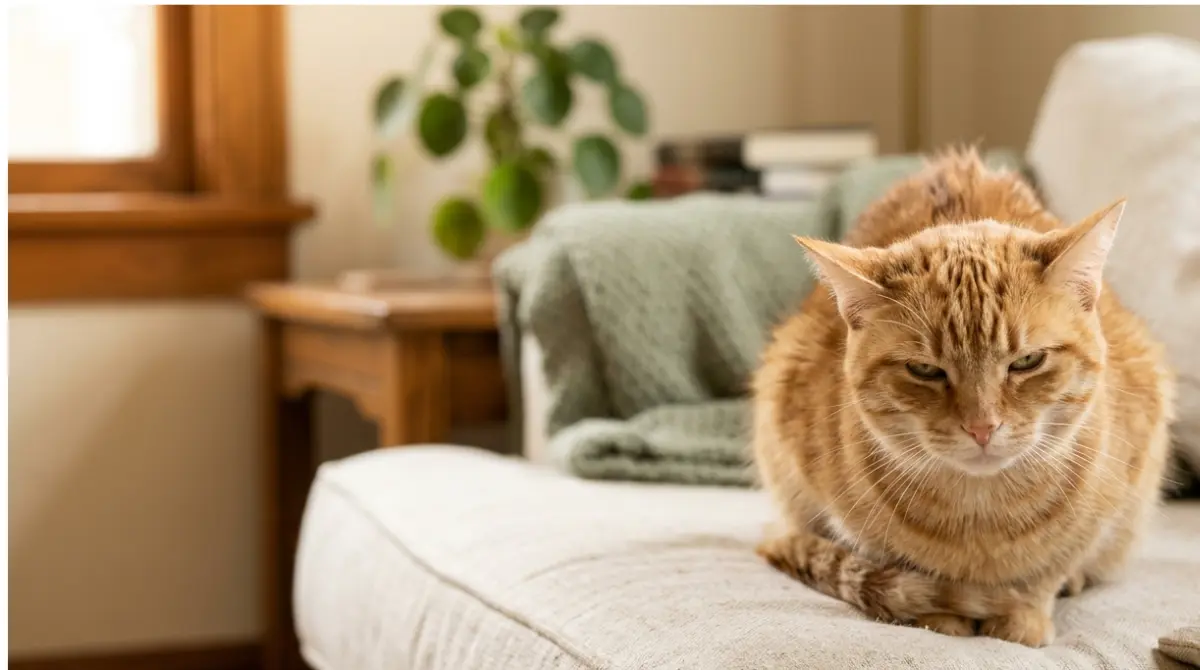
Table of Contents
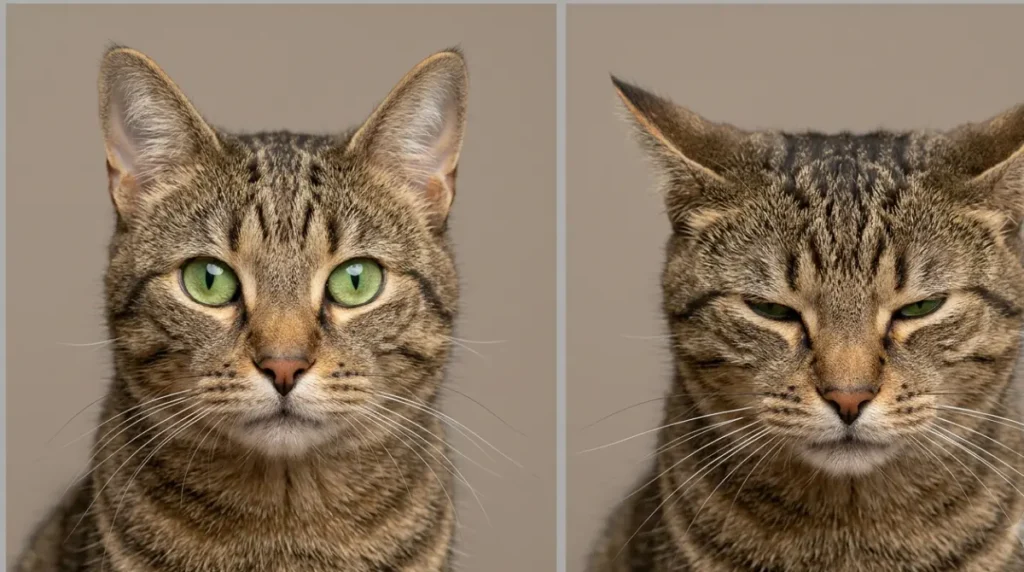
A cat in pain usually changes what she does long before she cries out: she jumps less or needs several tries, stops grooming, hides and eats less, and her face tightens, with ears pulled apart, squinted eyes, a tense muzzle, straightened whiskers and her head held low. Straining in the litter box with little or no urine, sudden weakness in the back legs, or any chance she swallowed a human painkiller means going to an emergency vet now.
For everything short of that, two checks at home tell you more than a guess. A 30-second face score picks up sudden pain, and six yes-or-no questions pick up the slow joint pain the face score misses.
Go to a vet now if: she strains in the box and little or nothing comes out, she suddenly can’t stand or drags her back legs, or she may have eaten a pain reliever made for people. Drive to the nearest emergency hospital and phone ahead. The page on which kind of clinic fits each emergency lists the other signs and the poison-control line.
Signs your cat is in pain, from habits to posture
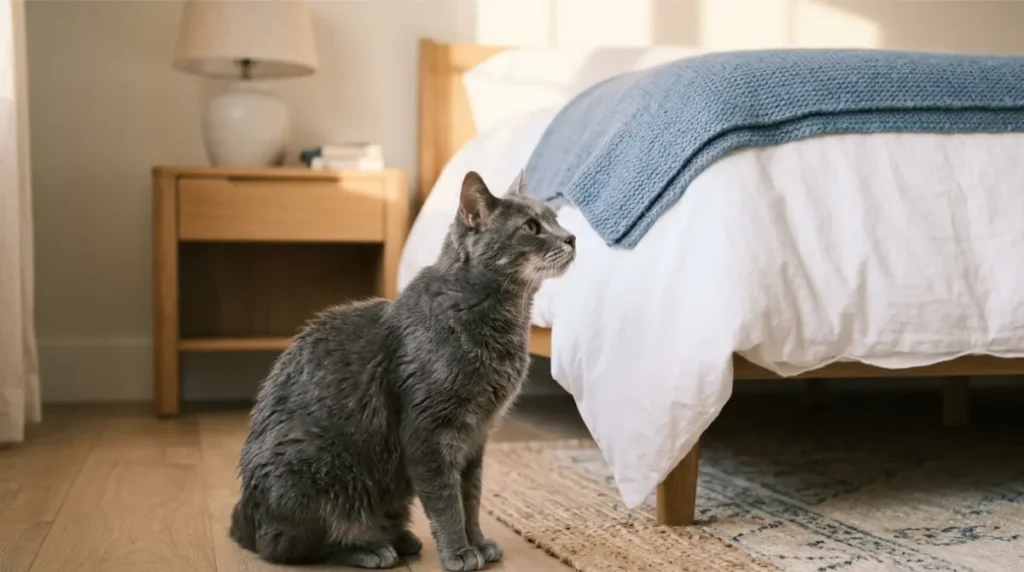
Nineteen veterinary experts in feline medicine agreed on 25 behaviors that point to pain, and on none that must be present for a cat to be hurting (Merola and Mills, PLoS One, 2016). The panel also rated how often each sign appears when pain is still mild, and the early signs turn out to be the everyday ones.
| What you see | Shows up even with mild pain | Mostly when pain is severe |
|---|---|---|
| Moving | Limping, a stiff or uneven walk, trouble jumping, moving less, shifting her weight | |
| Grooming | Coat left ungroomed, licking one spot over and over | |
| With you and at play | Hiding, playing less, rubbing on you less, a change in mood, flinching when touched | Growling, groaning |
| Body and face | Hunched posture, head held low, squinting | Eyes kept shut, avoiding bright light |
| Eating | Eating less | Eating differently, such as gulping or eating on one side |
Source: Merola and Mills (2016), expert consensus on behavioral signs of pain in cats.
Read the table across. A cat who still finishes her meals but has quietly stopped jumping onto the bed sits in the left column, and that alone is reason to book a visit this week.
Two sounds owners count on are weak signals. The same panel did not rate purring as a reliable sign of pain, and meowing or crying turned up mostly once pain was severe. A cat purring on your lap can still be sore.
Score her face in 30 seconds
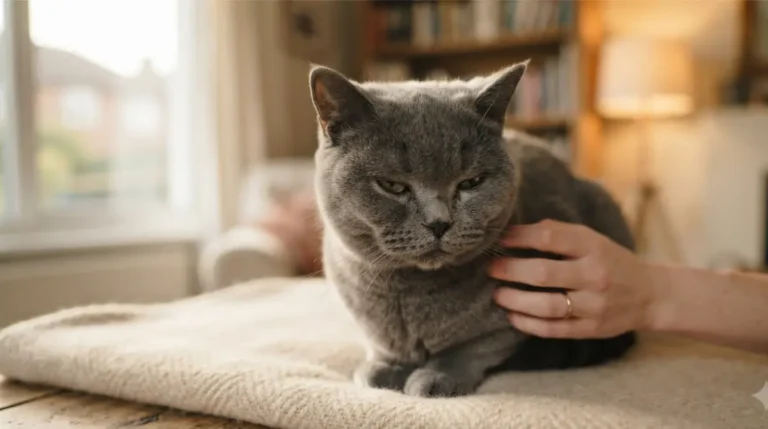
Wait until she is awake and settled, then watch her face from a few feet away for 30 seconds without touching or calling her (Feline Grimace Scale, Université de Montréal). If she starts grooming or eating, wait until she stops. Let a sleeping cat wake on her own, and look twice at one who seems asleep without being curled up, since a cat in pain can fake sleep (the scale’s caregiver FAQ).
The five face signs, scored 0 to 2
| Face sign | 0 | 1 | 2 |
|---|---|---|---|
| Ears | Facing forward | Slightly pulled apart | Flattened and turned outward |
| Eyes | Open | Partly open | Squinted |
| Muzzle | Relaxed and round | Mildly tense | Tense and oval |
| Whiskers | Loose and curved | Slightly curved or straight | Straight and pushed forward |
| Head | Above the shoulder line | Level with the shoulders | Below the shoulders or tilted down |
Source: Feline Grimace Scale scoring guide, Université de Montréal.
Add the five numbers for a total out of 10. A total of 4 or more means contacting your vet. At 3 or 4, when something still seems off, score her again in 15 to 20 minutes.
Two people scoring the same cat often land 1 or 2 points apart. Compare your own scores over time instead of yours against a partner’s. For how those same ears and whiskers read in a cat who isn’t hurting, see what ear, tail and whisker positions usually mean.
When one sign can’t be seen
A turned head or a shadow can hide part of the face. Score only what you can see, then divide your total by twice the number of signs you scored.
With the ears hidden, 3 points across the other four signs is 3 ÷ 8 = 0.375, just under the 4-in-10 line of 0.40. Four points across four signs is 4 ÷ 8 = 0.50, over it. Researchers who studied owners using the scale scored partial faces the same way, as a share of the points possible (Monteiro and colleagues, Journal of Feline Medicine and Surgery, 2023).
Do owners score as well as vets?
In that survey, more than 1,200 cat owners in 66 countries scored the same 10 photos as eight veterinarians, and the owners’ totals did not differ significantly from the vets’. Muzzle tension was the one exception, with owners scoring it higher. Owners agreed with one another best on eyes and ears, and least on whiskers and head position.
Two limits apply: owners scored photos rather than live cats, and most were reached through cat-welfare groups, so they were an engaged sample. The authors add that cats tend to be more relaxed at home than at a clinic, which is where an owner’s score is most useful.
The face scale misses arthritis pain
The grimace scale was validated for sudden pain only, and its developers say it isn’t reliable for a cat with a long-term condition such as osteoarthritis. Joint pain is common. NC State researchers estimate arthritis affects about 45% of all cats and 90% of cats over 10, and it rarely shows as a limp (NC State University). A cat with sore joints keeps doing the same things, only more slowly, or takes several tries to make the jump onto the bed.
Their six-question screen for owners:
- Does she jump up normally?
- Does she jump down normally?
- Does she climb up stairs or steps normally?
- Does she climb down stairs or steps normally?
- Does she run normally?
- Does she chase moving toys or prey?
A “no” to any of them is worth raising with your vet, even if she still eats well; the researchers built the questions to start that conversation. Stiffness in an older cat often gets put down to age, and senior cat behavior changes and when they point to illness sorts the other changes that show up after 10.
Notes and video for the vet visit
A short phone video of her jumping or walking at home shows what an exam room can’t, since the trip and the clinic itself can change how a cat moves and holds her face. Bring these too:
- each face score, with the time and what she had just been doing
- her answers to the six questions
- when the change started, and whether it came on over a day or over months
- any recent surgery or fall
- any medicine in the house she could have reached
The visit usually starts with a hands-on exam, followed by whatever tests the exam points to. What your vet will compare against her normal covers that side.
Note: give her no pain medicine of your own while you wait. Some painkillers made for people can kill a cat, and the scale’s developers ask owners to give nothing without a vet’s guidance.
Photograph her relaxed face this week
Pick a moment when she is awake and facing you in good light, and take one photo of her face. That photo is her baseline, the face every later score gets compared against. The free Feline Grimace Scale app for iPhone and Android lets you practice scoring before you need it.