Gentle Ways to Stop Cat Scratching Furniture and Save Your Sofa

Cat scratching furniture isn’t spite. It leaves scent and sheds worn claw sheaths, so here’s how to move the habit off your sofa.
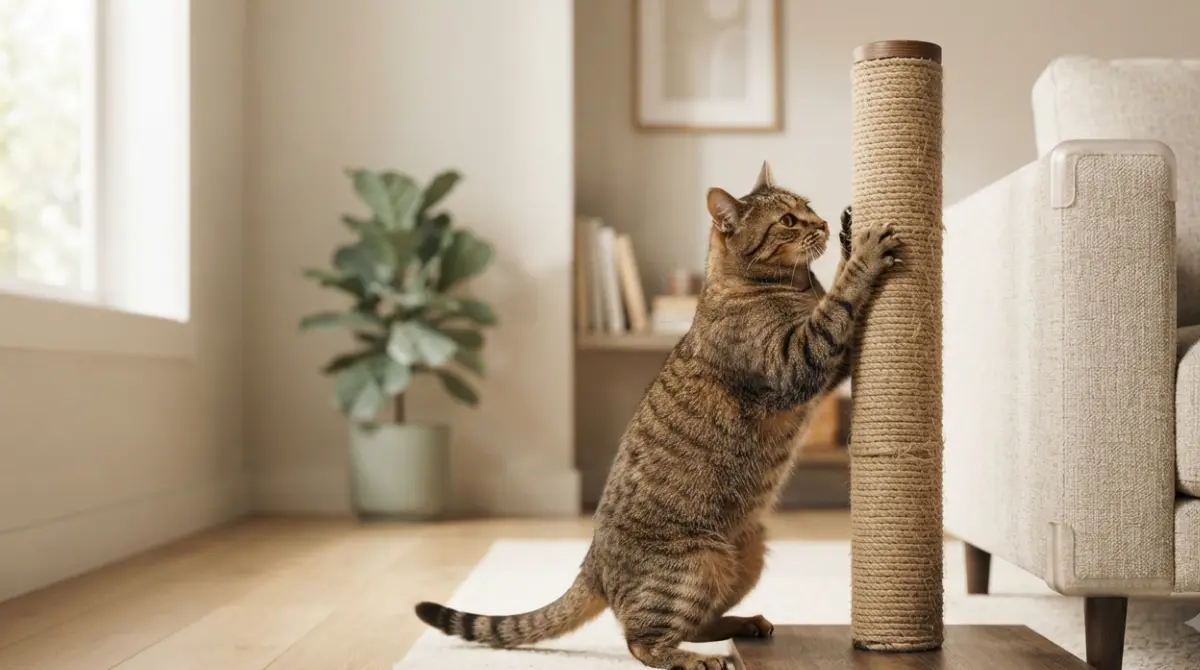
Table of Contents
Your cat isn’t wrecking the sofa to spite you
You can’t stop a cat from scratching, and you shouldn’t try. The way to stop cat scratching furniture is to move the habit: give your cat something better to scratch, right where the damage happens.
The 4-part fix in one line
Match a scratcher to your cat’s style, place it at the sofa, make the sofa less appealing, and reward every right choice. Most owners skip the matching step, and that’s why the new post sits unused.
Jump to your situation
- Your cat ignores the post you bought: start with the Scratch Preference Audit below.
- You have a kitten: habits form early, so read the life-stage note.
- You rent: go to the tape-and-cover deterrents.
- Scratching suddenly got worse: skip to the section on stress.
Why your cat picks the sofa, of all things
Scratching isn’t misbehavior. It does several jobs at once, and it’s one of the everyday behaviors in our guide to what’s normal in cats and what needs a vet.
Marking, claw care, and a good stretch
🔍 Why Cats Do This: Glands in the paws leave scent marks on whatever your cat scratches, and the motion strips off the worn outer sheath of each claw, according to Cornell’s feline behavior guidance. Scratching also maintains the claw movement cats use to climb and hunt, and it stretches the whole body.
Why the sofa wins: height, texture, location
A sofa is tall, sturdy and textured, and it sits where your family spends time. A 2024 survey of more than 1,200 cat owners also linked stress, heavy night-time activity and young children at home with more unwanted scratching.
Why your cat ignores the scratching post you bought
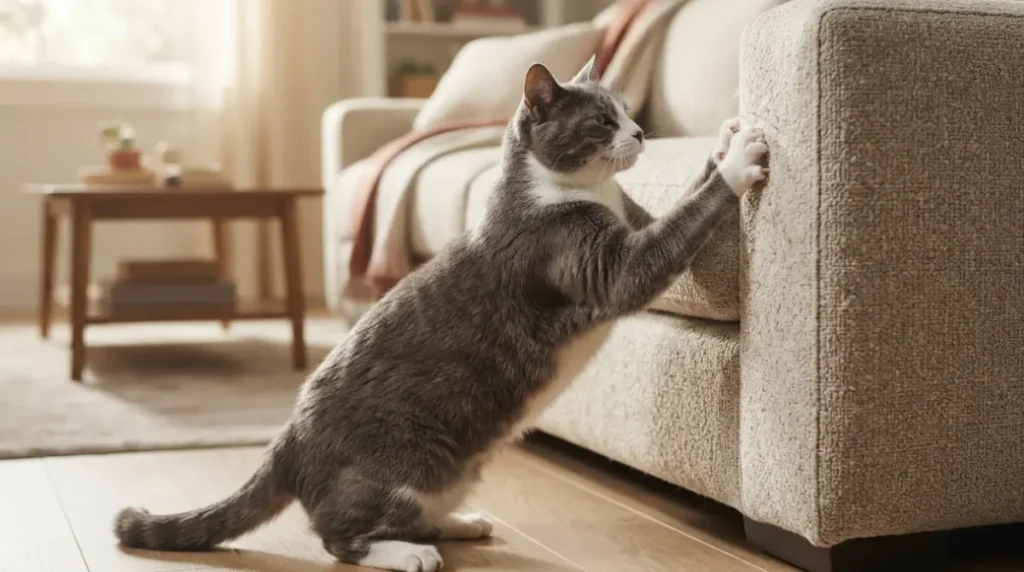
A post fails when it doesn’t match how your cat likes to scratch. Watch your cat at the sofa before you buy anything else.
The 2-minute Scratch Preference Audit
Note four things: whether your cat stretches up or rakes across, which texture it digs into, which spot it picks, and when it scratches. Then use the table below.
Match the scratcher to the style
| What you see | Scratcher to try | Where to put it |
|---|---|---|
| Stretches up the sofa arm or back | Tall post for a full stretch, heavy base | Right beside that arm |
| Rakes along the sofa base or rug | Flat cardboard scratcher or a log on its side | On the floor at that spot |
| Digs into nubby upholstery | Sisal-covered post | Against the damaged side |
| Goes for carpet | Carpet-covered post | Where it scratches carpet now |
| Scratches after naps or on its daily route | Any matched scratcher | Near its sleeping spot or regular path |
Sourced: Cornell Feline Health Center (texture, orientation); Frontiers in Veterinary Science, 2024 (placement).
Whatever you choose must not wobble or tip. A post that moves under your cat’s weight won’t be trusted.

Kittens, seniors, and big cats
🐾 Life-Stage Note: Scratching is partly learned, so kittenhood is the easiest time to set the habit. Our guide to kitten behavior from 8 to 16 weeks covers that window. Large cats need a taller, heavier post. If an older cat’s habits shift, read about senior cat behavior changes.
How to redirect scratching from your sofa, step by step
- Put a matched scratcher at the damaged spot.
- Make the sofa less appealing.
- Reward every use of the scratcher.
- Add a second scratcher where your cat rests.
Put the post right where the damage is
Place the scratching post beside the exact spot your cat uses, so it’s the easiest choice. The ASPCA’s scratching advice is to set posts next to covered furniture as the “legal” option.
Make the post the best spot in the room
Rub it with catnip or hang a toy from it. Give a treat or praise the moment your cat scratches it.
Multi-cat homes: more than one scratcher
Offer several scratchers in different spots, including places your cats pass daily and near where they sleep.
Move it gradually, once it’s a habit
Leave the post by the sofa until your cat uses it reliably. If you then move it, shift it a little at a time, and move it back if the sofa scratching returns.
Sofa deterrents that work, and ones to skip
Deterrents protect the sofa while the new habit forms. They only work alongside a scratcher your cat actually likes.
Tape, guards, and covers (renter-friendly)
Cover the spot with double-sided tape, a throw, or clear furniture guards. The ASPCA also suggests sandpaper, or an upside-down vinyl carpet runner where your cat stands to scratch.
Skip the water spray and yelling
Certified cat behavior consultant Mikel Delgado advises against yelling, chasing, or squirting cats with water. Reward the right choice instead.
Why we don’t recommend citrus oils
⚠️ Watch Out: Some guides suggest citrus sprays, but citrus oil is on Pet Poison Helpline’s list of essential oils that poison cats. Cats have trouble breaking these oils down. Skip homemade citrus or essential-oil sprays, and choose commercial deterrents labeled for use around cats.
Nail trims, nail caps, and why declawing isn’t the answer
Nail care won’t stop scratching, but it limits the damage while training works.
Regular nail trims
The ASPCA recommends clipping your cat’s nails regularly as part of protecting furniture.
Soft nail caps: what to know
Soft plastic caps fitted over the claws mean scratching does no damage, and the ASPCA lists them as an option. Follow the fitting instructions, and stop using them if your cat seems bothered.
Declawing: what it actually is, and where it’s banned
Declawing (onychectomy) is surgical amputation of the last bone of each toe, and the AAFP’s position on declawing is strong opposition to it as an elective procedure. New York’s declaw law allows it only for a therapeutic purpose. As of 2026, Maryland, Virginia, Massachusetts, Rhode Island, California and Washington, D.C. also prohibit or restrict elective declawing and some cities have their own bans.
✅ Do This: Ask your vet to show you a first nail trim or cap fitting, and talk to them before considering any procedure on your cat’s paws.
Still scratching? When it’s stress, not the sofa
If you’ve matched the scratcher and still see new damage, look at what else is happening at home.
New cat, new home, new baby: stress triggers
The 2024 study found stress was a leading reason for unwanted scratching. The researchers suggest safe hiding places, high perches, and several short play sessions that end with your cat “catching” the toy.
When to call your vet or a behavior consultant
If scratching changes suddenly along with hiding, appetite or litter box changes, read which behavior changes mean calling the vet and the signs your cat may be in pain. For a healthy cat with a stubborn habit, a certified cat behavior consultant (IAABC) can help.
Frequently asked questions
1. Why does my cat scratch the couch instead of the scratching post?
The post likely doesn’t match your cat’s style: vertical or horizontal, texture, or location. Match all three and place it beside the couch.
2. What smell stops cats scratching furniture?
Skip citrus and essential-oil sprays, because citrus oil is toxic to cats. Use tape, covers, or deterrents labeled for use around cats.
3. Does double-sided tape stop cats scratching furniture?
The ASPCA recommends it to make the spot less appealing. Pair it with a matched scratcher right beside the furniture.
4. Where should I put a scratching post?
Right next to the spot your cat scratches now, plus near where your cat sleeps or walks daily.
5. Can you train an older cat to stop scratching furniture?
Yes. Use the same steps: a matched scratcher, placed at the sofa, with deterrents and rewards.
6. Should I spray my cat with water for scratching furniture?
No. Behavior experts advise against spraying, yelling, or chasing. Reward your cat for using the scratcher instead.
7. Do nail caps hurt cats?
The ASPCA lists soft nail caps as an option. Follow the fitting instructions, and ask your vet if your cat seems bothered.
8. Is declawing illegal?
New York bans it except for medical reasons, and several other states and cities restrict it. Check your local law and talk to your vet.
9. How long does it take to stop a cat scratching furniture?
It depends on your cat’s age, how established the habit is, and how consistently you place, deter and reward.
10. Why has my cat suddenly started scratching more?
Stress is a leading cause. If it comes with hiding, appetite or litter box changes, contact your vet.
The short plan for a scratch-free sofa
Match the scratcher to your cat, put it at the damaged spot, make the sofa less appealing, and reward every right choice. Start with the two-minute audit today, because it tells you what to buy before you spend anything.