Emergency vet or urgent care for a cat behavior change

Urgent care waits usually run under two hours; emergency waits often top four. Which clinic a sudden change in your cat needs, and when your own vet fits.
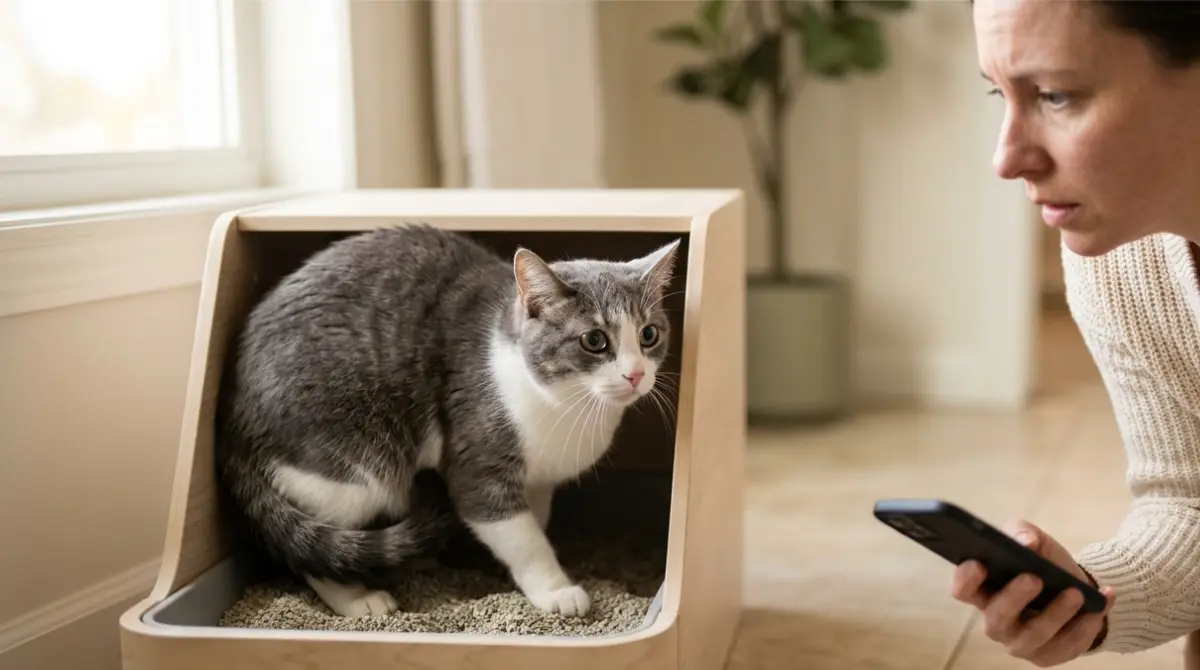
Table of Contents
Call your regular vet first whenever the clinic is open, because the team there has your cat’s records and can tell you by phone whether to come in today or go somewhere else. Go straight to the nearest emergency hospital instead, and phone them from the car, if your cat strains in the litter box with little or no urine, pants or works to breathe, cannot stand, or may have swallowed something toxic.
Urgent care sits between those two, and many owners have never used it. Which of the three fits depends on how stable the cat seems, how fast the change is moving, and whether your vet can see you today.
Go to a vet now if: you see any of the signs above, or your cat’s gums look blue or white. Drive to an emergency hospital and call ahead. For a possible poisoning, ASPCA Animal Poison Control answers 24 hours a day at (888) 426-4435, and a consultation fee may apply.
Signs that go straight to an emergency hospital
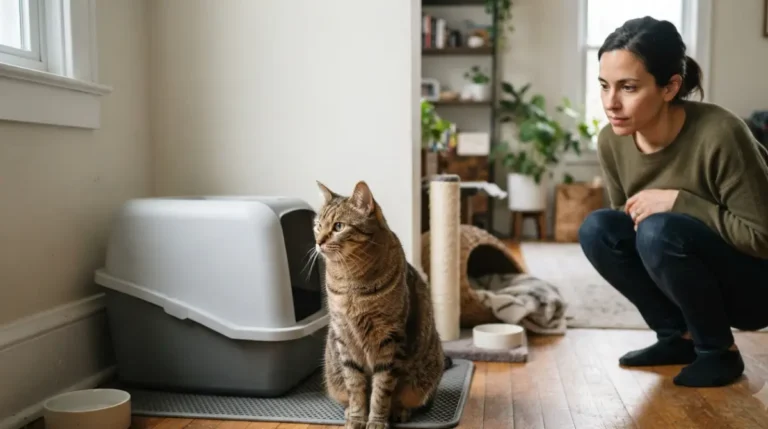
A cat hunched over the box, straining and crying while the litter stays dry, may have a blocked urethra. Urethral obstruction is a true medical emergency, and death can follow a complete blockage in less than 24 to 48 hours. Male cats face more risk because their urethra is longer and narrower.
Urgent care is the wrong first stop for this one. Clearing a blockage usually needs a urinary catheter placed under sedation, and the cat may then stay in hospital for days or weeks. Emergency hospitals are the only places equipped for emergency surgery and hospitalization (University of Minnesota College of Veterinary Medicine). If you cannot tell whether any urine is coming out, treat it as a blockage.
The same college’s urgent care veterinarian names the other signs that belong in the emergency room: a cat that pants, trouble breathing, blue or white gums, trouble standing or walking, severe lethargy, a belly that swells suddenly, vomiting that keeps food and water from staying down, and a swallowed object. Slower or milder changes are sorted by urgency in the sign-by-sign table of how fast each behavior change needs a vet.
Each kind of clinic handles different problems

| Your regular vet | Urgent care | Emergency hospital | |
|---|---|---|---|
| Open | Business hours, sometimes evenings or weekends | Evenings and weekends, some also daytime | Around the clock, or whenever regular clinics close |
| Getting seen | Booked appointments; schedules are often full | Same day; call ahead or walk in | Call ahead or walk in; the most severe cases go first |
| Equipped for | Checkups, long-term problems, signs that come and go | Sudden problems that aren’t life-threatening, with bloodwork, X-rays and IV fluids | Emergency surgery and hospitalization |
| Typical wait | Your appointment time | Usually under two hours | Often more than four hours |
| Cost | Usually lowest | Between the other two | Usually highest |
| Your cat’s history | Full records | Limited | Limited |
Source: University of Minnesota College of Veterinary Medicine.
The last row matters most for behavior. A change only means something against how your cat normally acts, and a vet meeting your cat for the first time has never seen that, so bring how long the change has lasted and a short video of it at home.
When is urgent care enough?
Urgent care fits a stable cat that can’t wait for a regular appointment, on a day your vet is closed or full. Urinary tract infections and limping are typical cases, and the team checks on arrival that your cat doesn’t need the emergency room instead.
For behavior changes, that usually means peeing outside the box, or more frequent trips, while urine is clearly coming out. A male cat making many trips with little to show for them goes to the emergency hospital instead. New limping or a sudden refusal to jump onto the bed also fits urgent care. Once infection and blockage are ruled out, why cats pee outside the litter box covers the house-soiling side.
Not eating is the change owners most often wait out. Loss of appetite can severely affect an adult cat’s health if it lasts as little as 24 hours, so a full day without food and no appointment today means urgent care today. For a kitten younger than six weeks, 12 hours without food can be lethal; get a kitten that young to whichever clinic is open now.
Hiding together with any of these moves the visit up a level, and hiding on its own has separate thresholds.
A slow change in a settled adult or senior cat
Mild tiredness and signs that come and go are primary care problems, according to the University of Minnesota’s urgent care veterinarian. The clinic you already use has past weights and exam notes to compare against, which a first-time vet lacks.
Book the first slot offered. If it is weeks away, tell the front desk exactly what changed and ask whether waiting is safe. Should the exam find nothing medical, a behavior professional is next, and what a cat behaviorist costs lays out the options.
Some slow changes are pain, which vets score from a cat’s face with the Feline Grimace Scale. In cats over 10, stiffness or new night yowling can trace to a treatable illness, and senior cat behavior changes and when they point to illness covers which ones.
Can a video call with a vet replace a visit?
Only in part. The AVMA’s position is that telemedicine belongs inside an existing veterinarian-client-patient relationship, which cannot be set up by phone or other electronic means alone. Without one, a vet can give general advice but should not diagnose or treat your cat, apart from emergency advice until the cat can be seen. States write their own definitions, so local rules may differ.
A video call with the clinic that already knows your cat is the useful version. An app vet who has never met your cat can help with one question, whether to go in tonight, and a yes still ends at a clinic. Poison control lines are staffed by veterinary toxicology experts and exist for exactly that kind of call.
What to tell the clinic and what to bring
Whoever answers the phone decides how fast your cat is seen, so have these facts ready:
- age and sex, and whether neutered or spayed
- what changed, and when your cat last acted normal
- when your cat last ate, and when you last saw urine in the box and roughly how much
- anything your cat may have chewed or swallowed, with the packaging or a photo of it
- medicines your cat takes, plus the name and number of your usual clinic so records can be shared
A cat who is hiding or sore may fight a front-door carrier. If yours opens at the top, lower your cat in from above, or lift the top half off, settle your cat in the base and refit the lid.
Save four numbers in your phone tonight
Add your vet, the nearest 24-hour emergency hospital, a local urgent care with its opening hours, and ASPCA Animal Poison Control at (888) 426-4435, all under one contact name such as “Cat emergency”. Check the emergency hospital’s drive time from home while nothing is wrong. If you have a male cat who has ever had urinary trouble, ask your vet at the next visit which emergency hospital they send blocked cats to, and save that one first.