Fixing apartment cat behavior starts with needs, not square feet

Cornell’s one-more-box rule and feline vet guidelines agree that one apartment cat needs two litter boxes. Screens come before any balcony time.
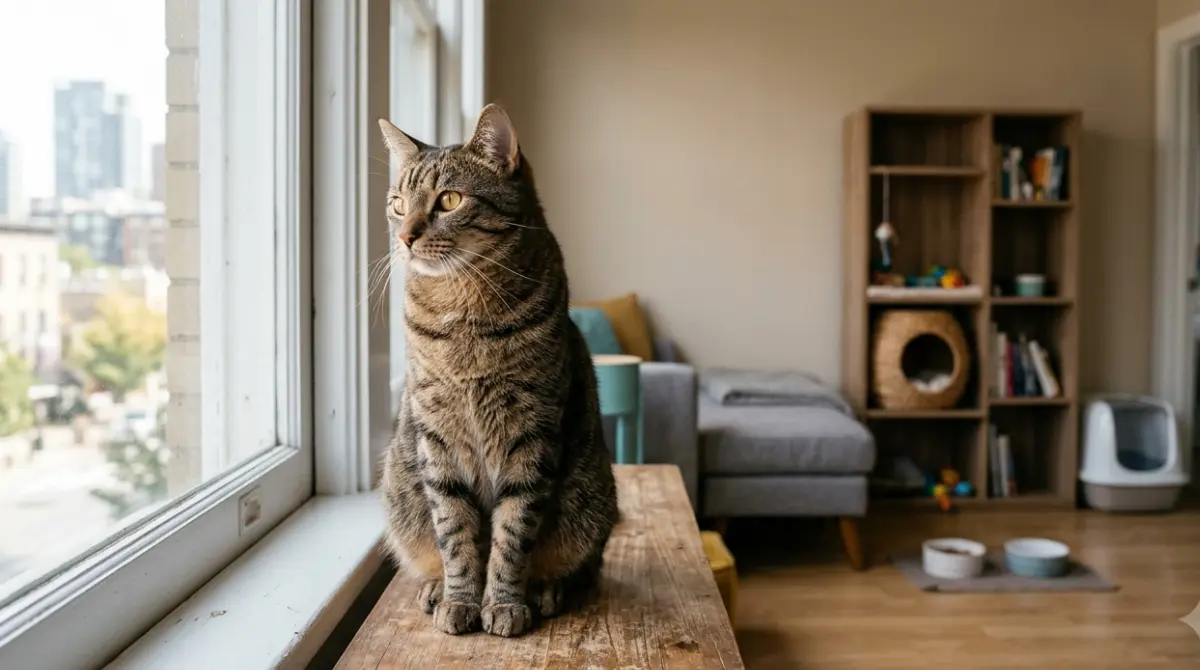
Table of Contents
Square footage is rarely what drives apartment cat behavior problems. The AAFP and ISFM feline environmental needs guidelines tie stress, illness and unwanted behavior to needs that go unmet, and a small home makes one of those needs hardest to meet: keeping food, water, litter and rest in separate places.
Check the litter box before blaming the apartment
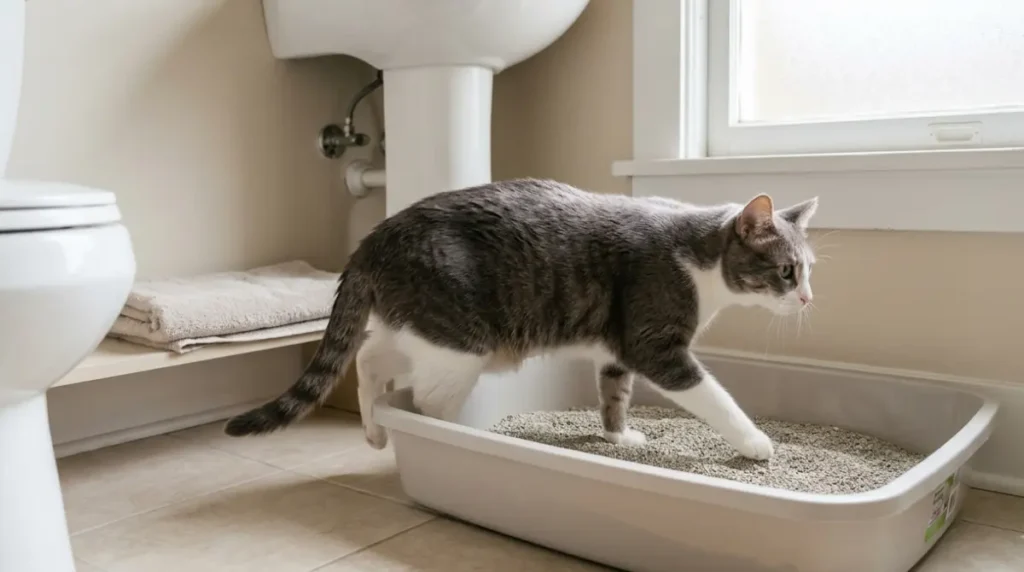
Before you buy a shelf or move a bowl, watch what your cat does in the litter box.
Urinary signs turn up most often in middle-aged, overweight cats that get little exercise, use an indoor litter box, have restricted outdoor access and drink less water, and living with other cats or moving house can add to the risk (Cornell Feline Health Center). That describes a lot of apartment cats. A cat who pees on the bath mat may be uncomfortable, and moving furniture won’t help her.
Cornell lists these as the most common signs:
- straining or pain when urinating
- more frequent trips to the box
- crying out while urinating
- blood in the urine
- urinating outside the litter box
- frequent licking of the genital area
Any one of them is a reason to call your vet before you change anything at home. A cat with a blocked urethra shows the same signs but passes little or no urine and grows more distressed. Cornell calls a blockage an absolute emergency, and the time from complete blockage to death can be less than 24 to 48 hours. Male cats face a higher risk because their urethra is longer and narrower.
Go to a vet now if: your cat keeps returning to the box or strains and little or no urine comes out, cries while trying, or seems more upset with each attempt. Call your vet or the nearest emergency vet and leave right away.
If the vet finds nothing medical, the setup becomes the next suspect. Other behavior changes that need a vet before a home fix go beyond the litter box.
Why a small home makes cats share everything
The 2013 guidelines ask that each key resource (food, water, toileting, scratching, play and rest) sit in its own location. Even a single cat should have a choice of each, with at least two resting areas, two feeding areas and two toileting areas, food and water kept apart, and generous space between the litter box and everything else (guidelines).
One-room living pushes those resources together, because the kitchen corner and the bathroom are the obvious spots for all of them. Spreading them out lowers stress and stress-related disease, and it gives the cat a reason to explore (guidelines).
Nowhere do the guidelines set a minimum floor area for a cat.
Resource placement for a studio or one-bedroom
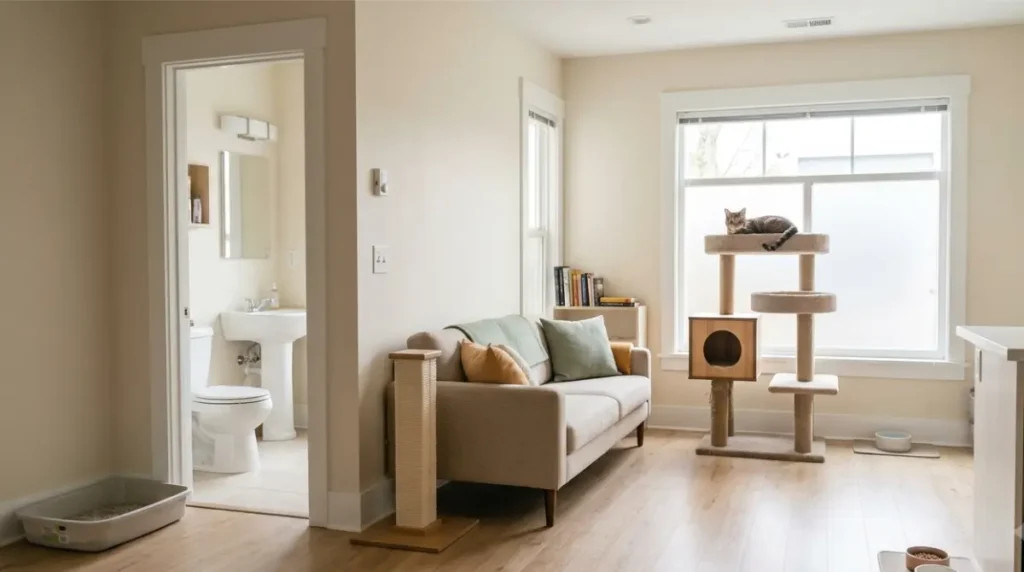
One common studio layout shows how the rules play out: bed, sofa and kitchen share one room, and the bathroom is the only door that shuts.
| Resource | What the sources ask | Studio | One-bedroom |
|---|---|---|---|
| Litter box | One more box than cats, kept clean, quiet, away from other resources | Bathroom, plus the corner farthest from the bowls | Bathroom, plus a quiet bedroom corner |
| Food | Two feeding spots, and a station for every cat | Kitchen area, plus a spot across the room | Kitchen, plus a spot in the bedroom |
| Water | Away from the food | Near the window perch | Living room |
| Safe place | Private, often raised, at least one per cat | Covered bed on a cat tree or high shelf; carrier left open | One in each room |
| Window rest | At least one resting spot with a view outside | Perch at the main window | Perch at a window in each room |
| Scratching | A place to leave scent through the paws | Beside the sofa and near the entry | Living room and bedroom |
Sources: AAFP and ISFM guidelines and Cornell Feline Health Center. The placements are examples to adapt to your floor plan.
For one cat, Cornell’s rule of one box more than the number of cats and the guidelines’ minimum of two toileting areas land on the same number: two boxes. Box size and counts for several cats are in how many litter boxes a cat needs and how big they should be.
Going up when the floor runs out
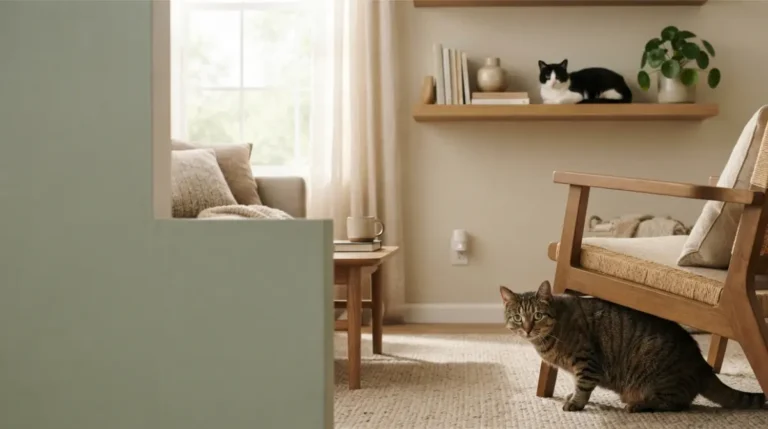
A studio has little floor to spare, but its walls run all the way up. Raised spots add territory and let a cat keep watch over the room. A good perch is wide and long enough for a full stretch, ideally with a hammock-style dip that helps her feel hidden (guidelines).
Kittens and older cats with limited mobility need those perches and hiding boxes set low, or reachable by a ramp.
If drilling into a rental wall is out, a sturdy bookcase or dresser under a window gives height without hardware. Perches at two or more windows let the cat “change channels” (Ohio State’s Indoor Pet Initiative). For a nervous cat, choosing a cat tree with a private hideout covers the features that matter.
Hallway noise, neighbors’ smells and the front door
Cats can hear the ultrasonic chatter of rodents, and loud or unfamiliar sounds can frighten them (guidelines). Apartments have their own: elevator doors, footsteps overhead, a neighbor’s renovation.
For construction or street work, give your cat a refuge with a radio or TV playing nearby to muffle the noise, and put a perch where outside sound is quietest (Ohio State’s Indoor Pet Initiative).
Shoes and shopping bags carry outside scents, so leave them at the entrance. Skip strong detergents and cleaners that change how home smells to a cat (guidelines). The same goes for the scented litter many owners buy to cover box odor in a small space. Leave the spots where your cat rubs her face unwiped.
Is the balcony or an open window safe?
The Animal Medical Center in New York treated 132 cats over five months in the 1980s after falls from buildings. Of those, 90 percent survived, many with chest, head and limb injuries (AMC). Cats don’t deliberately jump from dangerous heights; most fall by accident from windows, terraces and fire escapes, often while focused on a bird (ASPCA). A low floor is no protection: in one- or two-story buildings, a short fall leaves less time to turn and land (ASPCA).
Kittens and young cats fall more often, and older or less agile cats may be hurt more badly when they do (AMC).
Fit snug, sturdy screens in every window you open, and wedge adjustable screens tightly into the frame. Childproof window guards won’t do the job, since cats can slip through them (ASPCA). Keep balcony doors shut and don’t feed birds out there. A screened enclosure gives outdoor time without the drop, and so does a harness and loose leash once your cat has been positively trained to wear one (AMC; guidelines).
If your cat falls from any significant height, take her to an emergency vet immediately, even if she seems fine, because some injuries aren’t obvious (AMC).
When two cats share a small apartment
A second cat is often brought home as company for a bored apartment cat. In one room, that can mean two cats competing for every bowl and box.
Cats that eat or sleep near each other may be taking turns. Many cats in multi-cat homes “time share” a spot, using it at different times (guidelines). Give each cat its own feeding station and its own safe place, each with two exits so one cat can’t trap the other. Play with each cat separately, in different spots.
If you’re still deciding, adult cats generally accept a kitten more readily than another adult. A bonded pair such as littermates is also preferable to cats from different groups (guidelines). If a second cat is coming, follow a staged introduction for two cats before they share the main room.
Walk your apartment tonight and move one thing
Stand by the litter box tonight and look at what sits within a few feet of it. If the food or water bowl is there, move that one thing first, and watch how your cat uses the new spot before you change the next. Once the layout works and the night racing carries on, the play routine in spotting indoor cat boredom is the next place to look. Any sudden change in litter habits goes to the vet first.