Cats suddenly fighting? Find the cause, then reintroduce

When cats suddenly start fighting, one event is usually behind it, like a stray at the window or a vet visit. Reintroducing them can take weeks to months.
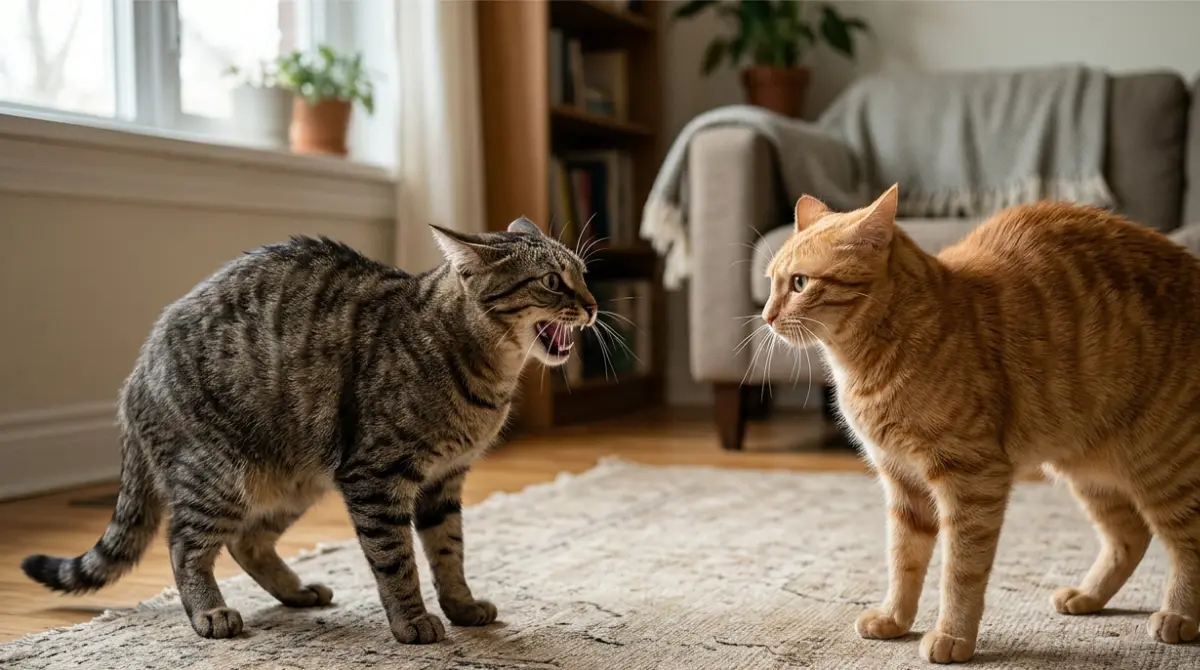
Table of Contents
When two cats who got along start fighting out of nowhere, one specific event is usually behind it: a fright one cat couldn’t act on, a cat coming home smelling of the vet, or pain. A sudden break between friendly cats accounts for just 3.1% of cases in the 2024 AAFP intercat tension guidelines, while 73.3% start with a new cat.
So a sudden fight is worth tracing back to what happened that day. Keep the cats apart tonight and check both for bite wounds before anything else.
Separate them, then check for bite wounds
Block their view of each other before you try to move either cat. A towel or a sheet of cardboard slid between them works, and it is worth keeping one within reach during any later meeting (Cat Friendly Homes).
Cornell’s Feline Health Center warns never to put a hand or any part of your body between fighting cats. A sharp noise that startles them without touching either one usually breaks their focus.
Once they part, guide one cat into a room with its own litter box and water, and close the door. Leave the cat who attacked alone until its pupils shrink back and its tail hangs loosely. A cat that is still that aroused can turn on whoever reaches for it.
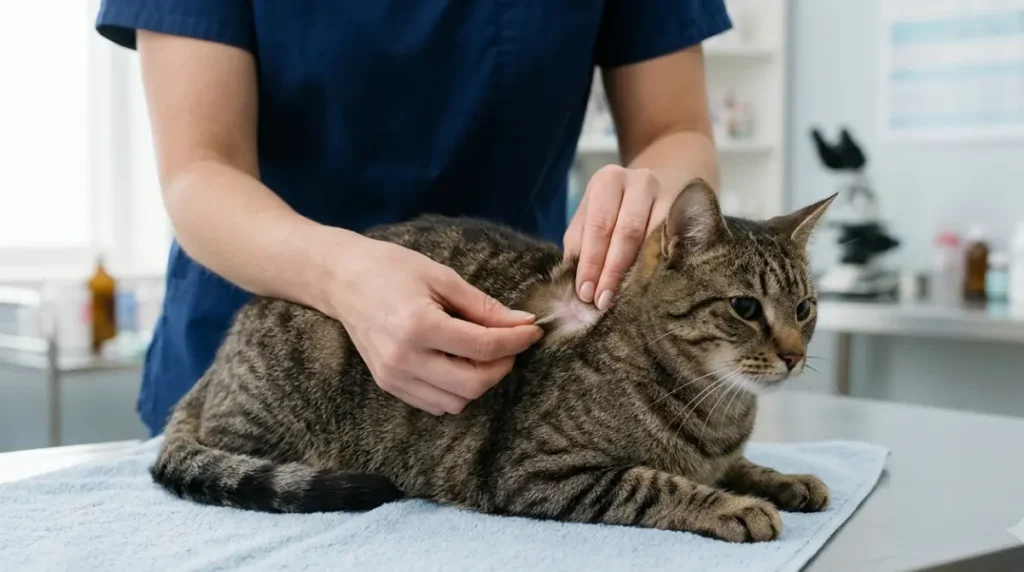
Then look both cats over in good light, parting the fur to find punctures or dried blood. If you were scratched or bitten breaking up the fight, that part is a question for your own doctor.
Go to a vet now if: either cat has a bite puncture or is bleeding, or a painful swelling shows up on one of them in the days after the fight.
Medical causes a vet will rule out
Cornell’s Feline Health Center lists hyperthyroidism, osteoarthritis, dental disease and central nervous system problems among the illnesses that can cause aggression, and puts a vet exam ahead of any behavior work.
Pain changes how a cat reacts to being crowded. A cat with sore joints may swat or bite to stop another cat from bumping it or making it move. From across the room, that looks like a personality change overnight. The signs are often quiet, so it helps to know how to read pain in a cat’s face and posture.
Call your vet the same day if either cat is hurt or the attacks keep coming with no clear cause. Otherwise, book a visit this week and ask for both cats to be examined. Tell the vet which cat started it, when, and what else has shifted lately: appetite, grooming, a limp, a recent procedure under anesthesia.
Other changes worth a call are listed in which cat behavior changes are normal and which need a vet. A clean exam moves the search to what happened at home.
What set off the first fight?
The hour before the first fight usually holds the answer. Match what you saw, or what changed that day, against these rows.
| What happened just before | Likely cause | What it tends to look like | First move |
|---|---|---|---|
| A stray cat at the window, or a loud noise | Redirected aggression: the aroused cat can’t reach what upset it, so it turns on a housemate | The cat that saw or heard it attacks whichever cat is closest | Block the view, then reintroduce once both settle |
| One cat came home from the vet or a hospital stay | The cat that stayed home treats the returning cat as an outsider | The home cat hisses at or attacks the one that came back | Keep the returning cat in its own room and start with scent |
| A cat between 2 and 4 years old | Aggression that can surface at social maturity, mostly toward other males | Swatting and chasing aimed at another male cat | Make sure every cat is spayed or neutered, then reintroduce |
| A cat limping or flinching when touched | Pain-induced aggression | The sore cat swats when the other comes near | Vet visit first |
| One feeding spot or one litter area for several cats | Competition over resources | Guarding the food bowl or litter box | Spread bowls and boxes around the home |
Sources: Cornell Feline Health Center; 2024 AAFP intercat tension guidelines brief.
Redirected aggression often goes unnoticed, because the stray cat or the bang that started it is usually gone by the time you come running. A drawn blind, or a deterrent that keeps stray cats off the sill, removes that cause at the window (Cornell). If noise is the pattern in your house, a plan for cats during fireworks covers that side.
Scolding the cat who attacked, or squirting it with water, adds stress at the worst moment. The AAFP guidelines trace tension between cats to stressors such as pain or too few safe resources, and they name reprimanding as something to stop.
How to reintroduce cats after a fight
Reintroduction takes weeks and sometimes months, depending on the cats (Cornell). It starts with one cat settled in a separate room while the other keeps the rest of the house.
- Keep one cat in that room with its own supplies for a few days. Swap a blanket or bed between the two sides each day, so each cat gets used to the other’s scent again.
- Swap the cats’ spaces for about 30 minutes a day, over several days.
- Let them see each other while eating. Put them in carriers, or on harnesses held by two adults, at opposite ends of one room and feed them. If either won’t eat, move them farther apart; bring them a little closer each session.
- Release both in the same room at a distance and feed them while you watch.
- Leave them together under supervision for longer stretches, then most of the time, then all the time.
If either cat stares or hisses at any stage, go back one step and stay there until both eat and move around normally. Pushing ahead while tension is still showing can leave it in place for the long term (AAFP).
Timings and detail for each stage are in the step-by-step guide to introducing two cats.
Give each cat its own route to food and litter
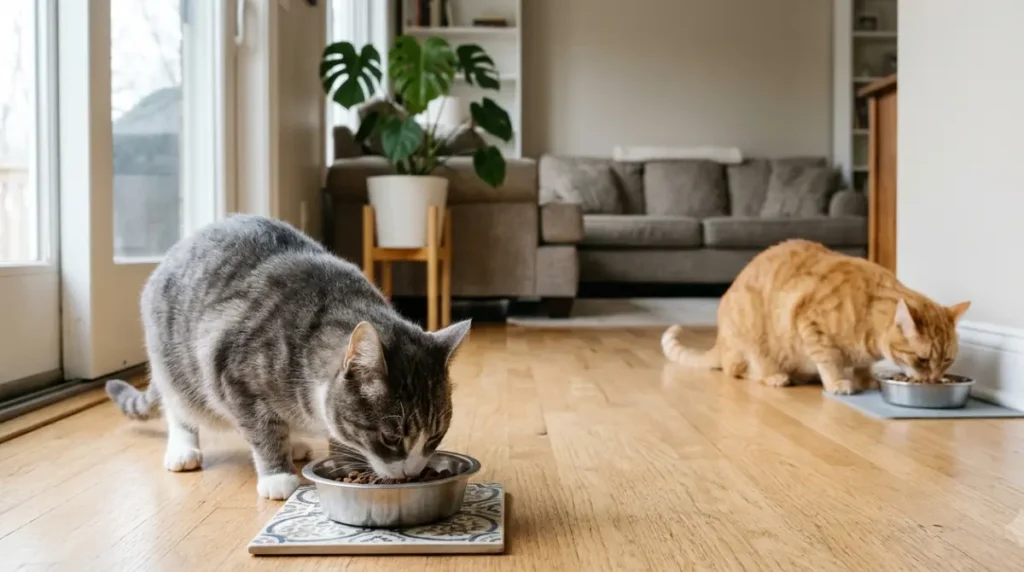
Separate rooms stop the fighting for now. The layout of the house decides whether it starts again once the door opens.
- Feed each cat in its own spot, out of sight of the other (AAFP).
- Put litter boxes in different rooms, so neither cat has to pass the other to reach one, and check how many litter boxes a multi-cat home needs while you’re moving them.
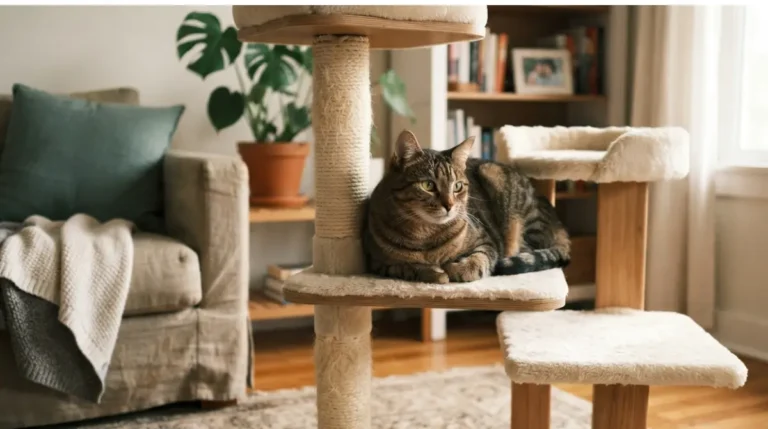
- Add high perches and a box with tall sides, so a cat being chased can climb or hide out of view.
- Give the more energetic cat two or more play sessions a day of at least 5 minutes, so its energy goes into a toy instead of the quieter cat.
In a multi-cat home: cats that groom each other and sleep touching belong to one group. Give each group its own feeding and litter spots, and play with each group separately.
Play fights and pheromone diffusers
Is it play or a real fight?
Play goes both ways: the cats take turns chasing, and either one may start it. When only one cat ever does the chasing, it isn’t play (Cat Friendly Homes). A short tussle is little concern if both cats are friendly at their next meeting and the tussles aren’t getting more frequent.
Pheromone diffusers during the reintroduction
Synthetic feline pheromones are meant to work together with the reintroduction steps (AAFP). A diffuser can support the process, and the steps still set its pace.
Fights that keep happening need a behaviorist
If one cat keeps staring at or chasing the other despite these changes, the problem needs more than home adjustments. Staring is the most common sign of tension that hasn’t eased, seen in 44.9% of cases, followed by blocking and chasing (AAFP).
Ask your vet for a referral to a board-certified veterinary behaviorist; Cat Friendly Homes lists the directories where you can find one. Only a licensed veterinarian can prescribe medication, and any medication is used together with the gradual steps (Cornell). It also helps to know what a cat behavior consult costs before you book.
Some pairs never share a home comfortably again. When cats cannot live together, rehoming one may be the most humane option (AAFP).
Before that vet call, write down what happened just before the first fight and the furthest step the cats have reached, and bring that page to the appointment.